
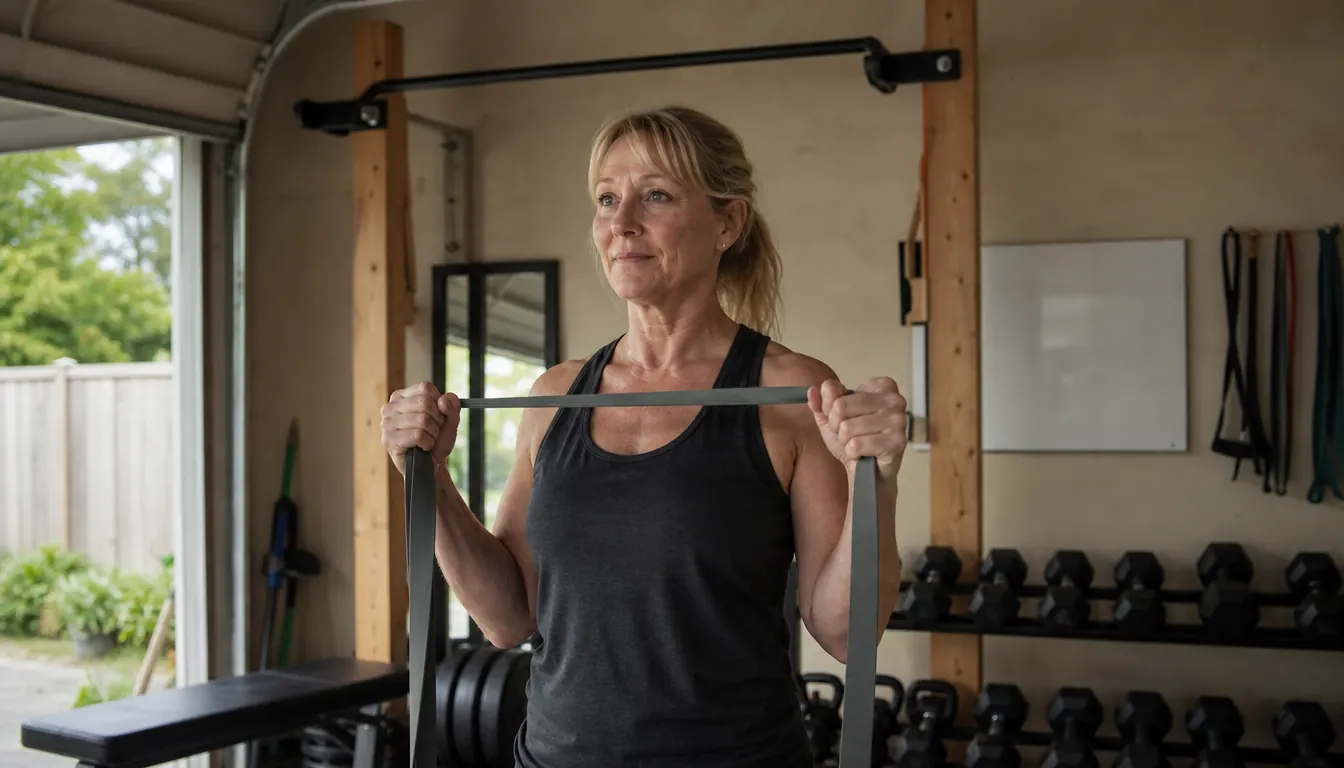
I have coached enough high school track to know that most people do not fail at pull-ups because they are weak. They fail because they start with a movement their body is not ready for, and then they decide pull-ups are not for them. I was close to that place myself. At 58, after years of coaching from the infield and a right knee that does not like deep squats anymore, I looked up at the bar in my garage and figured my pull-up days were behind me. Then I hung a set of Sanakma resistance bands on a hook next to it, and I found a way to train the movement without fighting my own body weight every single rep.
Start where you can actually pull
The Sanakma set gives you five resistance levels, a door anchor, foam handles, three carabiners, and a storage bag, so you can begin with the band that lets you do a full range of motion today.
Amazon Check Today's Price on Amazon →Step 1: Hang the bands and learn the lightest pull
I keep my Sanakma bands on a hook in the garage, right beside the pull-up bar. The set comes with five loops in five resistance levels, from the yellow band at 5 to 15 pounds up to the green band at 50 to 125 pounds. The color on the package tells you the range, but the real test is how it feels when you put weight on it. My first afternoon, I looped the green band over the bar, put one foot in the bottom, and let it take some of my weight. That is the whole trick. You are not doing a pull-up yet. You are learning what it feels like to hang, to pull, and to lower yourself under control. The first time I stepped into the green band, I expected it to make the pull-up feel like nothing. It did not. Even with the most help the set offers, my arms shook on the way down and I let go after two reps. Glenn walked through the garage and asked if I was okay. I told him I was fine, just humbled. I wrote the date in a small notebook I keep on the bench: May 12. Not a goal, just the band I used and how many reps I managed, so I could compare later.
Find the band that lets you do three or four slow reps with decent form. For me that was the green band, the heaviest in the set, because it carried the most of my weight. If even the green band leaves you shaking at first, that is fine. The point of this step is not to be impressive. It is to give your shoulders, your grip, and your brain a version of the movement they can handle. I did this for two weeks before I even thought about counting reps. By the end of the first week, I could do four slow reps on the green band without shaking. By the second week, it felt almost easy, so I jumped ahead to the black band. That was my first mistake, and I am glad I made it early. The black band gives far less help than the green, which meant my arms had to work much harder, and my right shoulder complained for two days. I went back to the green band and stayed there until the movement felt smooth. The lesson stuck: the band is a tool, not a badge.
Step 2: Do assisted negatives, slowly
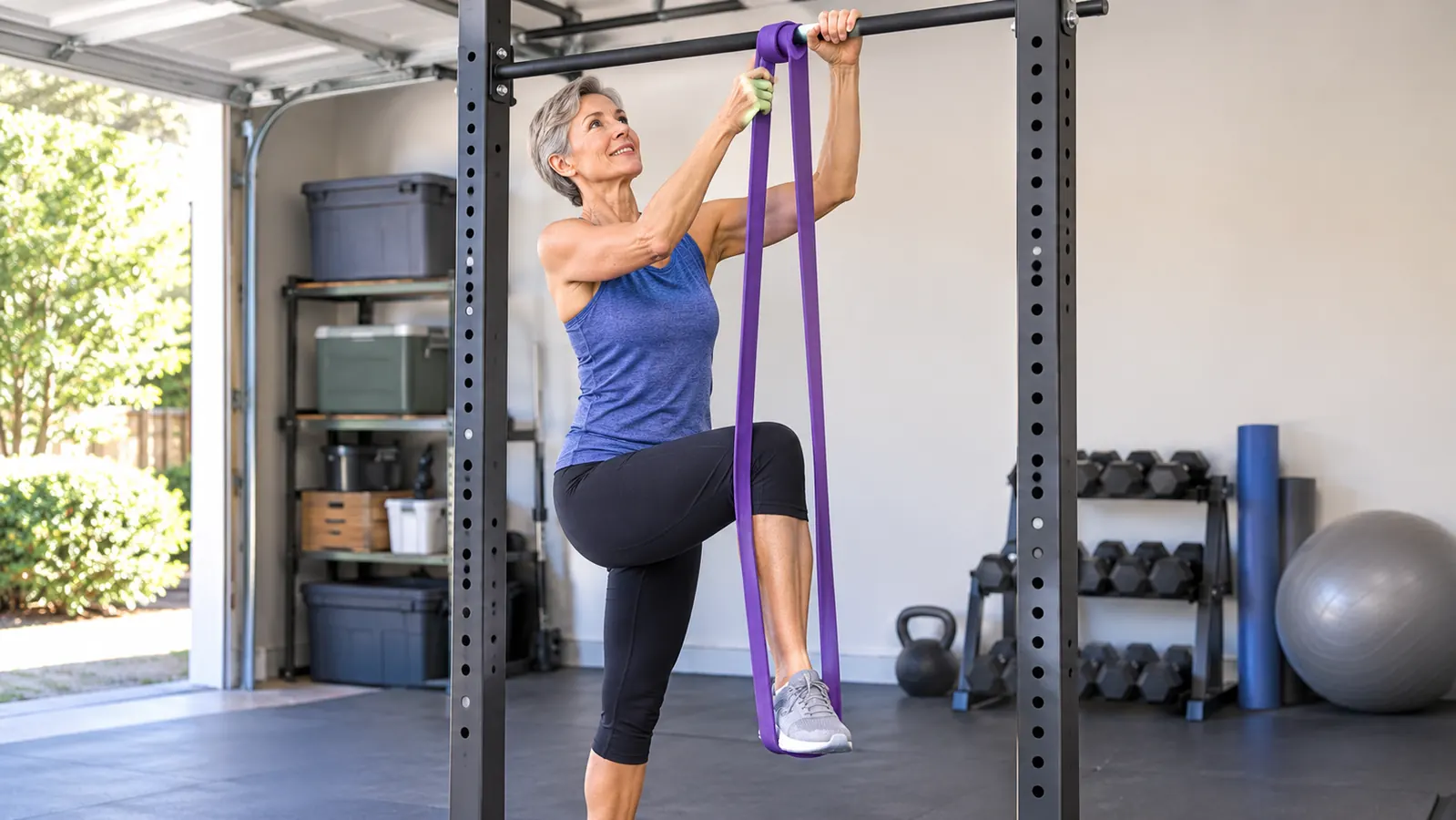
A negative is the part of the pull-up where you lower yourself from the top. It is the half of the movement that most people skip, and it is the half that builds the strength to do the whole thing. With the band under one foot, I jumped or stepped up to the top of the pull-up, chin over the bar, and then lowered myself as slowly as I could. The green Sanakma band caught some of my weight on the way down, so my arms had to work, but they did not have to do everything. The first negative I ever did was ugly. I jumped up, got my chin over the bar, and dropped like a sack of potatoes because I did not have the strength to lower myself slowly. That was without any band, and it taught me exactly why the green band mattered. With the band under my foot, I could control the lowering, but only just barely. I picked a Tuesday morning when the garage was cool and I had the house to myself.
I started with three negatives of about five seconds each. After a couple of weeks, I stretched them to eight seconds and added a fourth rep. The rule I used was simple: if I could not control the lowering, I was using a band that was too light, so I went back to the green band for another week. The natural rubber loops stretch smoothly, which matters more than you would think. A band that jerks or fights you on the way down teaches your body the wrong timing. The five-second count felt like an eternity at first. I would count in my head, one Mississippi, two Mississippi, and by three my arms were shaking. By the fourth week, five seconds felt normal, so I moved to eight. The day I did four controlled negatives in a row without my feet touching the ground between reps, I wrote 'four eights' in the notebook and underlined it twice. I also learned to keep my shoulders packed, which is a fancy way of saying I stopped letting them creep up toward my ears.
Step 3: Build the rowing strength the pull-up needs
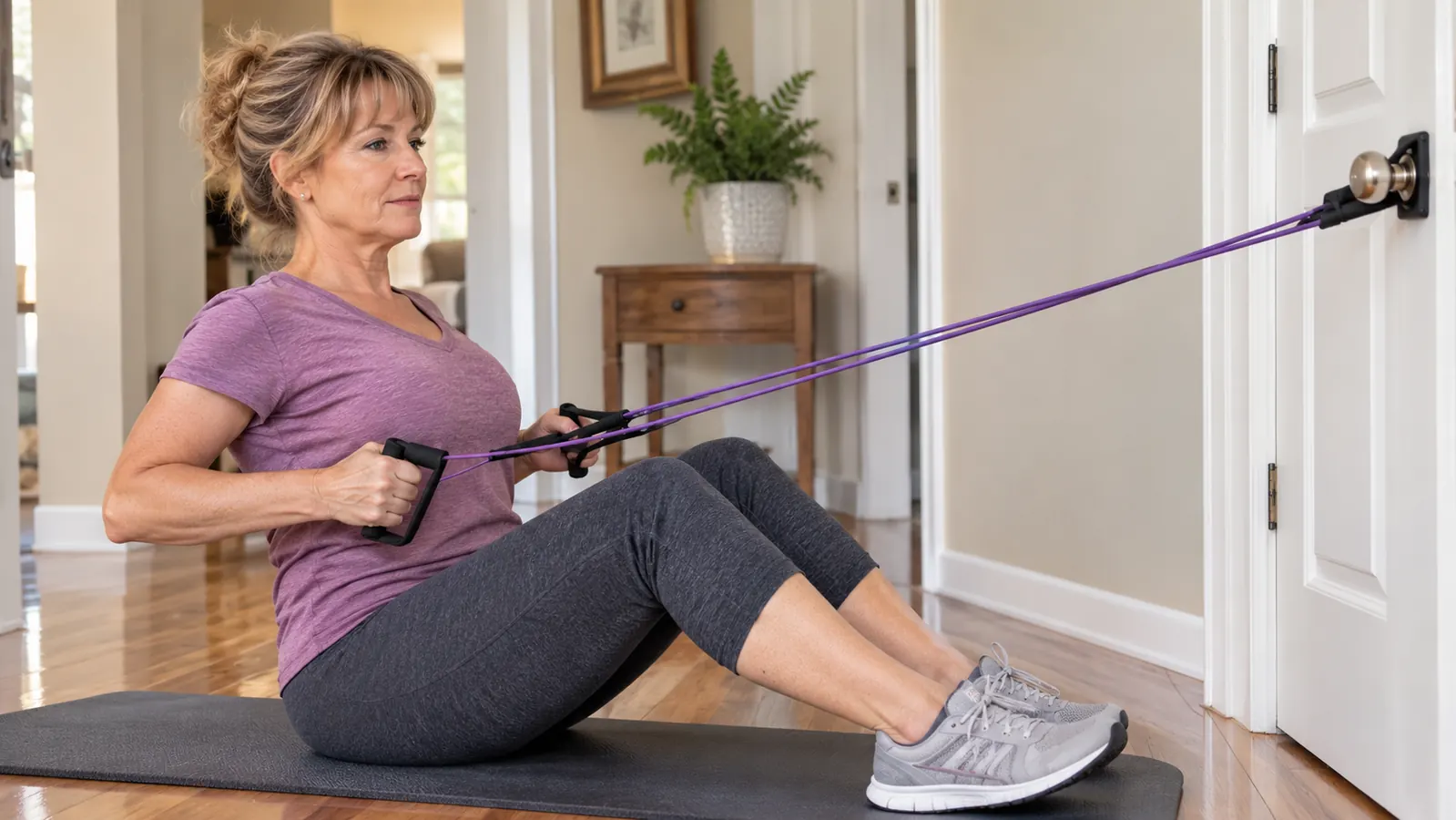
A pull-up is not just an arm exercise. It is a back exercise, and the back strength has to come from somewhere. This is where the door anchor earns its place. I clip the anchor into the door from the garage into the house, close the door, and do seated rows with the yellow and red bands. The yellow band is 5 to 15 pounds and the red is 15 to 35 pounds, and both come with the foam handles. I sit on the floor, brace my feet, and pull the handles to my ribs for three sets of twelve, twice a week. The first time I did seated rows with the red band, I thought I was being tough. I lasted six reps on the first set, and my lower back, the one that gets tight after yard work, let me know about it for two days. I dropped back to the yellow band and did three sets of twelve with clean form. The row is not about the heaviest band you can yank. It is about pulling your shoulder blades together and holding them there.
I also do band presses and shoulder work with the same handles, because the muscles that hold you steady at the top of a pull-up are the ones that get neglected when you only do pushing exercises. The Sanakma set is marketed as a home alternative to gym equipment, and for this purpose that is exactly what it is. You are not trying to replicate a lat pulldown machine. You are building the specific pulling strength that carries over to the bar. The foam handles matter more than I expected. My grip gives out before my back does on some days, and the handles let me hold on without digging into my palms. I also use the yellow band for band pull-aparts, which sound silly and are surprisingly effective. I hold the band at chest height, pull it apart until my shoulder blades touch, and slowly bring it back. Twenty of those before a pull-up session wake up the muscles that keep my shoulders stable.
Step 4: Move down a band when the current one gets easy
This is the step that separates a set of bands from a piece of gym equipment that gathers dust. The Sanakma set has five levels for a reason. You start on the heaviest band that lets you do the movement, and you move to a lighter band when the current one stops challenging you. I started on the green band in May. By late summer, I was doing sets of eight assisted pull-ups on the green band without much strain, so I switched to the purple band. The difference was humbling and exactly what I needed. I remember the exact workout I switched bands. It was a Thursday in late August, and I had just finished three sets of eight assisted pull-ups on the green band. The last rep of the last set felt like the first rep of the first set. I stood there for a minute, looked at the purple band hanging on the hook, and decided to try one set with it. I got four reps, barely. That was enough to tell me the green band had done its job.
The way I know it is time to move down: I can finish my last set and feel like I could do three more. When that happens two or three workouts in a row, the band has done its job and it is time to make the movement harder. Do not rush this. I spent more than three months on the green band, and I do not think that was wasted time. The slow progress is what protects your shoulders and your ego. The rule I use now: if I can finish my last set and immediately think about doing three more, the band is too easy. If I am counting the seconds until the set ends, the band is too hard. Somewhere in between is the band that is teaching me something. That is the one I keep using until it stops teaching. I also learned not to judge a workout by how sore I felt the next day. The best sessions were the ones where I finished and felt like I could do more, because that is what let me come back two days later and do it again.
Step 5: Test a lighter band on your freshest day
Once a week, on a strength morning when my arms feel fresh, I try one set with the next lighter band, and then one slow, controlled lowering from the bar with no band at all. I do not train for it that day. I just walk up to the bar, take a breath, and see what happens. I still cannot do a full pull-up without a band, and at 58 I am not sure I ever will. I am telling you because the test day is what kept me honest for five months, and it is how I know the purple band is the right one for me now.
If the test does not go well, that is information, not failure. It tells you which band to use for the next few weeks and which muscles need more work. The Sanakma bands are still on the hook in my garage, and I still use the purple band for extra volume on days when I want more pulling work without wearing out my shoulders. The goal was never to throw the bands away. It was to make the bar feel possible again.
What Else Helps
The bands did the heavy lifting, but a few other habits made the progress stick. I do my strength work three mornings a week in the garage, and I keep the pull-up work at the start of the session when my arms are fresh. I also do hill walks on the other days, which keep my whole body feeling solid without adding extra strain to my joints. On the evenings after leg days, I use my massage gun and take my magnesium glycinate as part of my usual wind-down. None of that is medical advice, and I am not claiming any of it caused my progress. It is just the routine that made me consistent enough to keep showing up.
I started on the green band in May. By late summer I was doing sets of eight assisted pull-ups, and now I am on the purple band.
Give yourself five months and five bands
The Sanakma resistance band set is still the first thing I reach for on pull-up day. It hangs on a hook, takes two minutes to set up, and it meets you exactly where you are.
Amazon Check Today's Price on Amazon →