
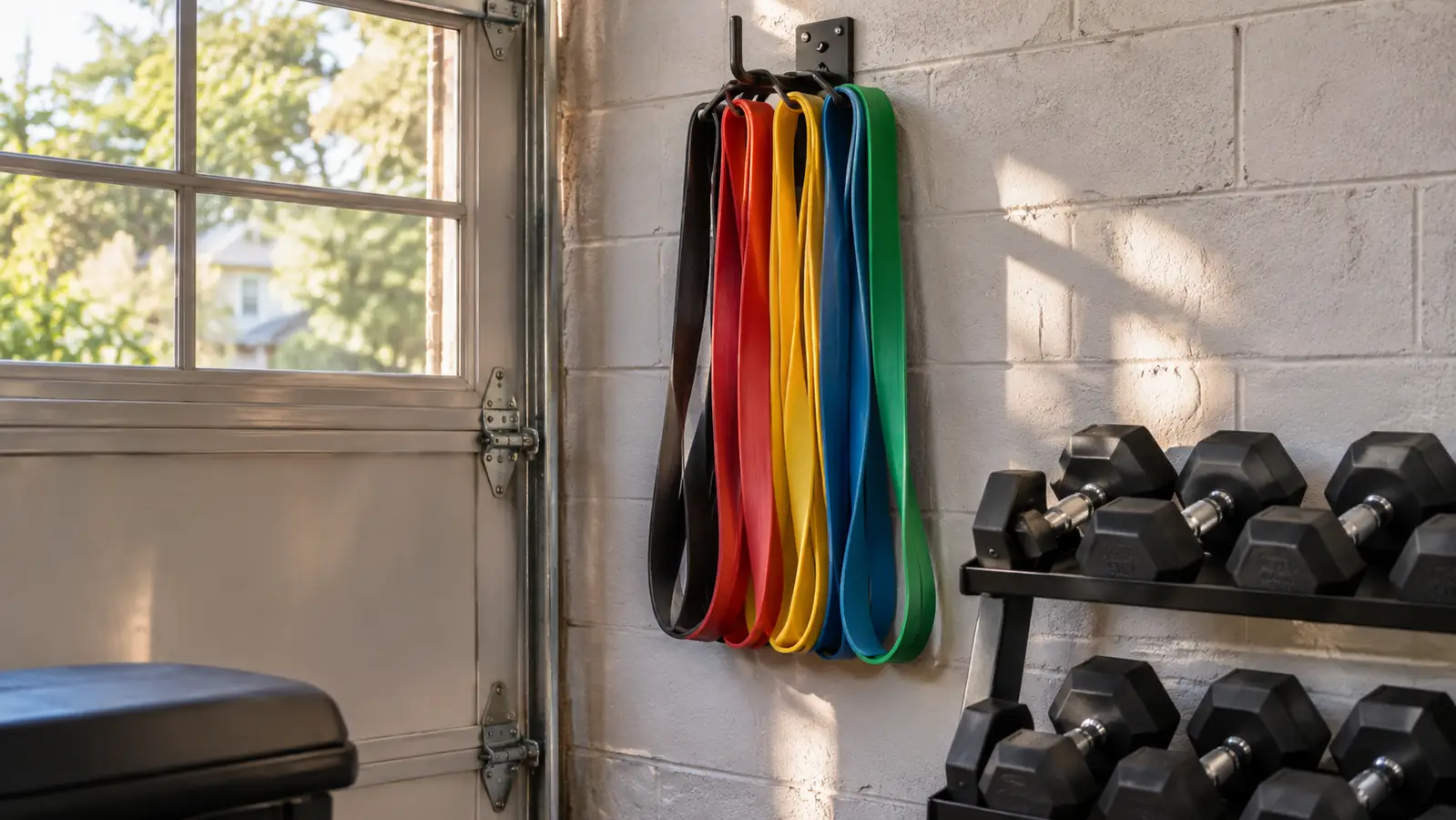
Three mornings a week I walk into my garage, pick up a dumbbell, and do the same lifts I have done for years. Then, last May, I hung a set of Sanakma resistance bands on a hook beside them. Six months later, both still earn their spot, but not for the reasons I expected. If you are over 40 and trying to decide which one deserves the floor space, here is the short answer: keep the dumbbells for the lifts you love, and add the Sanakma bands for the things dumbbells are bad at.
I am Renee Pellerin, 58, a retired high school track coach in Chattanooga. My garage gym is small: a pair of dumbbells, a flat bench, a pull-up bar, and now those five Sanakma bands hanging on a hook. I have a stiff right knee and a tight lower back after long days of yard work, so I care less about maxing out a lift than about still being able to do it next year. This comparison is about what each tool actually earns in a gym like mine.
The bands were not an either-or decision for me. I bought them in May for one specific reason: the pull-up bar had been bolted to the garage ceiling for two years and I had never once done a full pull-up. My right knee, stiff from decades of coaching on a track, made me cautious about adding more weight to the dumbbell rack, and a full set of heavier pairs cost more than I wanted to spend on a maybe. The Sanakma set was the cheaper experiment. I figured the risk was small, about the cost of a single pair of mid-range dumbbells, and if it did not work, the whole thing would sit in its storage bag and I would be out the space of one hook. The package arrived on a Tuesday, and I opened it in the garage that same afternoon, right before my walk with Glenn. My first session was clumsy. I clipped a band to the door anchor, sat down for a row, and learned the hard way that a band needs tension before the first rep, otherwise the handle just sits in your hand. It took two sessions to get the setup right. Instead, it changed how I warm up, how I do pull-ups, and how I think about what a garage gym is for.
| Sanakma Resistance Bands | Dumbbells | |
|---|---|---|
| Price | One set covers five resistance levels, about the cost of a single pair of mid-range dumbbells | A full set of pairs costs several times more, and you keep buying heavier pairs as you progress |
| Storage | The whole set weighs 2.8 pounds and fits in one storage bag on a hook | A set of pairs takes a rack, floor space, or a whole wall |
| Adding weight | You switch bands or stack them, but the jumps between levels are wide | You buy or pick up the next pair, and the jump is exactly what you choose |
| Assisted pull-ups | The heaviest band loops over the pull-up bar and takes weight off, which is how I worked up to unassisted reps | Dumbbells cannot help with a pull-up at all |
| Warm-ups and shoulders | The yellow and red bands with foam handles are my first choice for rotator cuff work and warm-up sets | Dumbbells work, but every warm-up rep is harder to control at low weight |
| Joint comfort | Natural rubber bands start light and load smoothly, which is gentler on a stiff knee during warm-ups | Working sets with dumbbells are harder on a joint that has not warmed up yet |
| Material | Natural rubber, elastic by design, and it will wear out eventually | Metal heads that will outlast you |
| Travel | The whole set goes in a suitcase and sets up on any door | Dumbbells stay home, and so does your routine |
| Best for | Portable, joint-friendly work, assistance moves, and travel | Heavy progressive overload and the lifts you want to measure in pounds |
Where Sanakma Bands Win
The first thing you notice is the space. The Sanakma set is five bands, a door anchor, two foam handles, three carabiners, and an exercise guide, and the whole thing weighs 2.8 pounds. It lives in a storage bag on a hook. My dumbbells take up a rack and a corner of the garage, and I have only three pairs. If I traveled, the bands would go in a suitcase. The dumbbells would stay home.
The bigger win for me is assisted pull-ups. I started on the green band, the heaviest of the five, looped over my pull-up bar, and worked down to the purple band over the summer. No dumbbell can do that. The first time I looped it over the bar and stepped in, it took so much weight off that I nearly floated up, and I laughed out loud in the garage. Glenn heard me through the door and asked what was funny. I told him I had just done my first assisted pull-up at 58 years old. The door anchor also gives me rows and presses I cannot set up with dumbbells alone, and on days when my right knee is stiff, the yellow and red bands with foam handles are easier on it than picking up a heavy pair from the floor. The bands let me train around the parts of me that are 58 instead of pretending they are not.
In May, I could not do one pull-up. I would jump to the bar, get my chin an inch over it, and hang there. The green band took enough weight off that I could do three slow reps with good form. By the Fourth of July I was doing five. By September I had moved to the purple band, and on a good Tuesday I can do eight controlled reps. The dumbbells in my garage never once helped me with that.
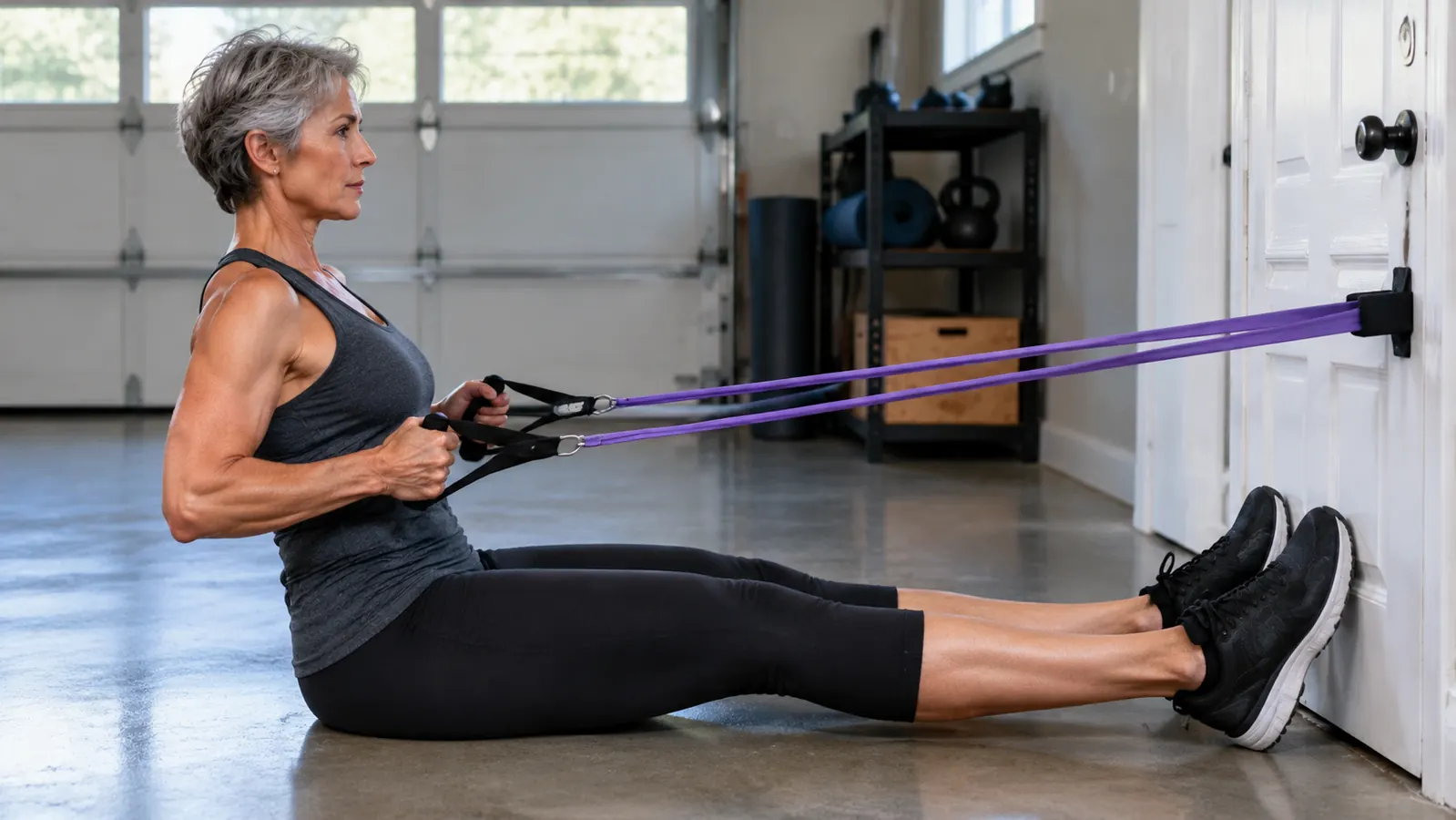
The door anchor lives in the door from the garage into the house. I clip a band to it, close the door, and do seated rows and chest presses without moving the bench. On a rainy Tuesday when I did not feel like setting up, I did three sets of rows, two of presses, and a set of band pull-aparts in about fifteen minutes, then hung the band back on the hook. That is the real argument for the bands: they lower the cost of starting. The dumbbells are better for a planned session. The bands are better for the days when a planned session is the last thing you want.
My warm-up used to be a few half-hearted swings with the lightest dumbbell I own. Now it is ten minutes with the yellow band, which the listing rates at 5 to 15 pounds, and the red band at 15 to 35 pounds, both with the foam handles. I do band pull-aparts for my shoulders, banded walks for my hips, and slow rows for my lower back. The yellow band is about 0.3 inches wide and the red about 0.5 inches, so they are easy to hold. On the mornings when my right knee complains, I do a few light banded squats before I pick up anything heavy, and that alone has made more difference than any warm-up I did in my forties. I time it to a podcast and stop when the episode ends, which is the only way I have ever stuck with a warm-up. Before the bands, my warm-up was two minutes of marching in place and a lot of hoping.
Where Dumbbells Win
I am not going to pretend the bands do everything. The resistance curve on a band is not the same as a dumbbell. The band gets harder as it stretches, so the hardest part of a row is at the top, where you are strongest, and the easiest part is at the start, where you are weakest. A dumbbell gives you the same load through the whole range. For the lifts I want to measure, like a set of shoulder presses or a goblet squat, the dumbbell is the honest number. I know exactly what I lifted last week because the dumbbell does not change.
Dumbbells also win on small jumps in weight. The Sanakma bands have five levels, and the jumps between them are wide. The yellow band covers 5 to 15 pounds, the red covers 15 to 35, and the black covers 25 to 65, which is a forty-pound window. When I am between levels, I can stack two bands, but it is not the same as reaching for the next pair of dumbbells. If your main goal is progressive overload on a handful of core lifts, dumbbells are the clearer path. The bands are the accessory, not the anchor.
Last Tuesday is a good example. I did three sets of shoulder presses with the 20-pound dumbbells, twelve reps, ten reps, and eight reps, and I wrote it on the index card I keep on the bench. That card goes back to 2019. I know that in March I was doing ten, eight, and six at the same weight, so I am genuinely stronger. With the bands, I cannot keep that kind of record. The resistance depends on how far the band stretches, which depends on where I anchor it and how I stand, so the same band can feel like a different weight on different days. That is fine for assistance work. It is a poor way to run a progressive program.
The goblet squat is the lift I trust the most for my right knee. I hold one dumbbell at my chest and squat slow, and the weight is constant all the way down and all the way up. A banded squat does not feel the same, because the band pulls harder as you stand, which loads the knee most right at the top of the movement. I still do banded squats as a warm-up, but I do my working sets with the dumbbell. If my knee is the thing I am trying to protect, I want the load I can predict.
The other thing dumbbells give me is a number I can trust. When I tell Glenn I did twelve reps at twenty-five pounds, we both know exactly what that means. Bands are sold in ranges, 5 to 15 pounds, 15 to 35 pounds, because the actual load depends on the stretch, and the stretch depends on the exercise and the person. That is not a flaw, it is the nature of the tool. But if your goal is to add weight to a lift in a measurable way, week after week, a dumbbell is the clearer instrument. The bands are for the work that does not need a number. On the index card on the bench, every entry has a date, a weight, and a rep count. The band work does not go on the card, and that is fine. It earns its place in other ways, like the morning I realized I had done a full set of assisted pull-ups on the purple band without once thinking about my knee.
Five resistance levels, one hook, zero excuses
The Sanakma set covers everything from light shoulder work to assisted pull-ups, and it folds into a bag when you are done. That is the version of a garage gym that actually survives a busy week.
Amazon Check Today's Price on Amazon →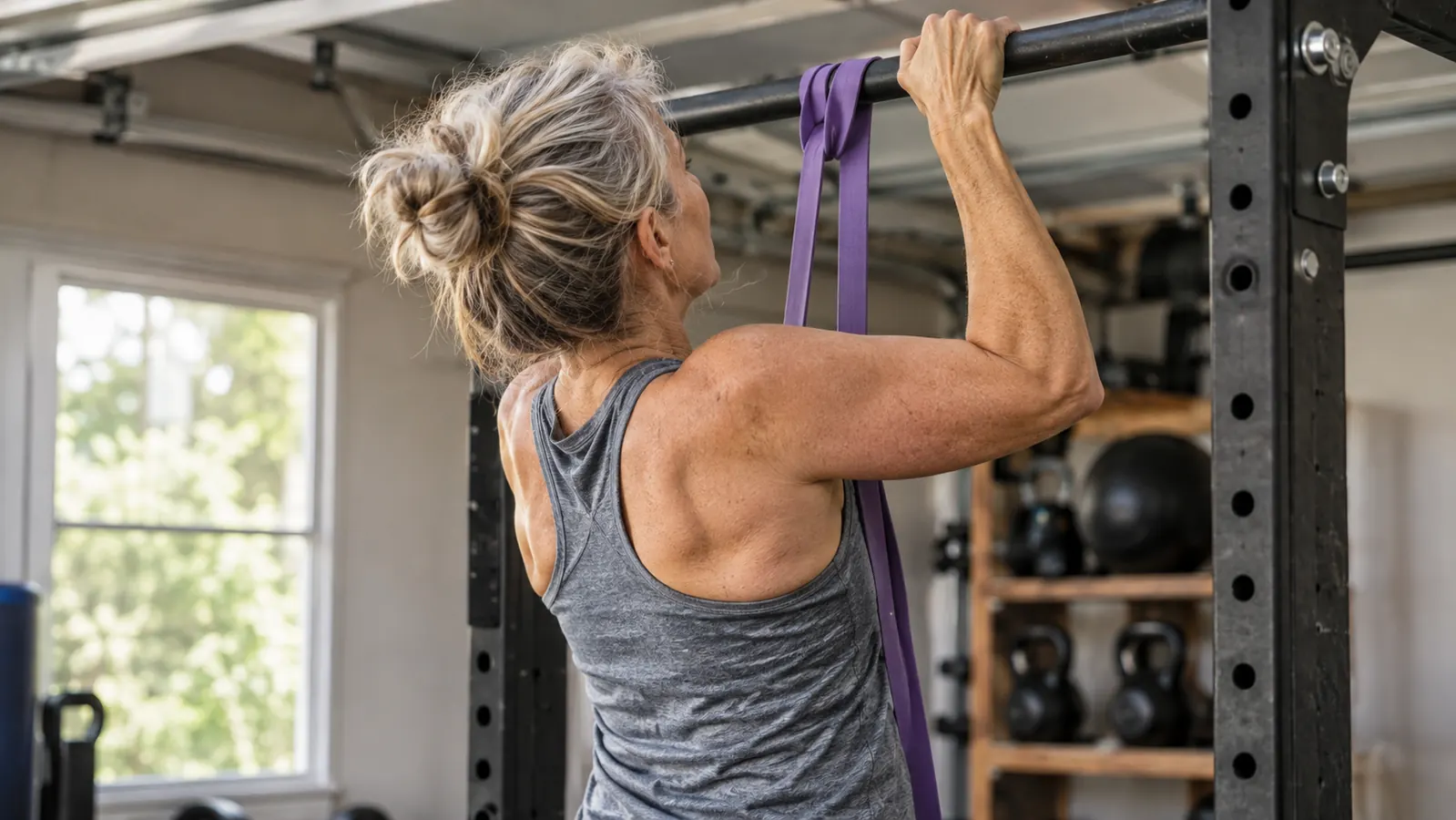
Who Should Buy Which
Buy the Sanakma bands first if you are starting from an empty corner, if you travel, if your joints complain about heavy weights, or if you have a pull-up bar you are not using because you cannot do a full pull-up yet. The set is cheap, takes up no space, and covers warm-ups, assistance work, and a surprising amount of a full-body routine. It is the lowest-risk piece of equipment I own.
Buy dumbbells first if you already know the five or six lifts you want to do for the next ten years, if you like measuring progress in exact pounds, and if you have the floor space and the budget for a real set of pairs. Most of us over 40 end up with both eventually. I did. But if I could only keep one, I would keep the dumbbells for the heavy basics and buy the Sanakma set to fill in everything they cannot do. That combination, not either tool alone, is what my garage gym is built around now.
If you are trying to decide on a budget, start with the bands. They are the lower-risk bet, and they will tell you quickly whether you will actually use a home gym. If the bands sit on the hook for a month, you have learned something valuable before spending on a rack of dumbbells. If you use them every week, you will know exactly which dumbbell pairs to buy next. That is how I would do it again, and it is how I have talked two friends through it.
One more thing, and it is the thing I wish someone had told me at 45: the two tools do not compete, they cover for each other. On the days my back is tight from yard work, I do band work and skip the heavy stuff. On the days I feel strong, I do the dumbbell lifts and use the bands only to warm up. The garage gym got more useful the week I stopped treating this as a choice between them.
The set that fills the gaps dumbbells leave open
Assisted pull-ups, door-anchor rows, shoulder work, and a gym that packs into a bag. The Sanakma set is the other half of a practical garage gym.
Amazon Check Today's Price on Amazon →