
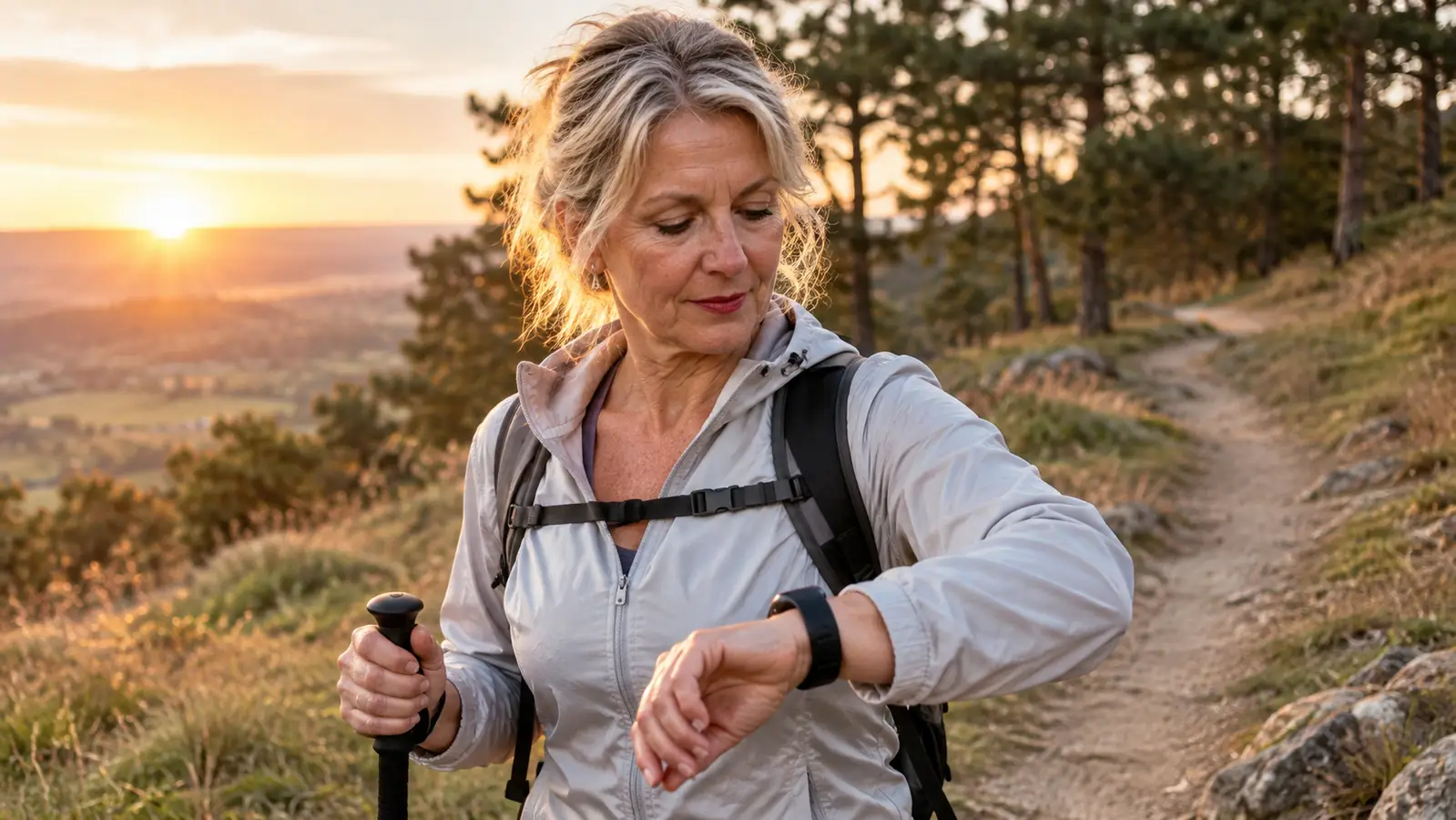
I wore the Fitbit Charge 6 for five months and the Garmin Vivosmart 5 for three weeks, and the short answer is that most active adults over 40 will do fine with either one. The Fitbit is the one I kept on my wrist. It has built-in GPS, the morning sleep view I actually look at, and a screen I can read on a bright morning, and those three things matter more to me than the Garmin's lighter weight and longer battery life.
To be clear about who is writing this: I am a 58-year-old former high school track coach in Chattanooga, Tennessee. I lift three mornings a week in my garage, walk hills with my husband Glenn most evenings, and play pickleball on Saturdays. I bought the Fitbit Charge 6 in May 2026 and wore it day and night. When the Garmin arrived for this comparison, I wore it for three straight weeks before I wrote a word about either one.
| Fitbit Charge 6 | Garmin Vivosmart 5 | |
|---|---|---|
| Built-in GPS | Built-in GPS for walks and runs without your phone | No built-in GPS; uses your phone's location |
| Battery life | About a week with typical use | Up to a week, often a day or two longer |
| Contactless payments | Tap-to-pay built in | Not available |
| Display | Larger LCD screen, readable in daylight | Smaller, more discreet screen |
| Weight and feel | 5 ounces with a silicone band | Lighter and slimmer on the wrist |
| Sleep and recovery tools | Sleep Score, Daily Readiness, ECG | Body Battery, stress tracking, Pulse Ox |
| Typical price | Usually the higher-priced option | Usually the lower-priced option |
Where Fitbit Charge 6 Wins
The built-in GPS is the biggest reason I stayed with the Fitbit. On my hill walks I can leave my phone in the car and still get a map of the route, with pace and heart rate matched to where I actually was. The Garmin needs your phone nearby for location, and on a humid Chattanooga afternoon the last thing I want is a phone strapped to my arm or stuffed in a pocket. For a woman who walks hills four or five days a week, that difference shows up every single time I head out the door.
Both trackers list contactless payments, and I have not used them on either one, so that is not what decided it for me. The display mattered more. The Charge 6 screen is larger and easier to read in sunlight, which counts when you are glancing at it mid-stride. The Garmin's smaller screen is more discreet, but I found myself squinting at it on bright days.
Where Garmin Vivosmart 5 Wins
The Garmin is the more comfortable tracker for someone who wants to forget they are wearing it. It is lighter and slimmer, and the band sits closer to the wrist. I sleep with a tracker on, and I noticed the difference on the first night. The Fitbit is not heavy at 5 ounces, but the Garmin disappears in a way the Fitbit does not. If you are someone who hates the feel of a watch, the Vivosmart is the easier adjustment.
The Garmin also stretches its battery further and usually costs less. Both trackers get me through about a week, but the Vivosmart tended to go a day or two longer in my testing, which means fewer nights thinking about when to charge it. And it is typically the lower-priced option, which matters if you are not sure a tracker will earn its place in your routine. I would not argue with anyone who picks the Garmin for those two reasons alone.
The tracker I kept on my wrist for five months
The Fitbit Charge 6 is the one I wore day and night. Built-in GPS and a screen I can read in daylight, all in a package that tracks sleep, heart rate, and Daily Readiness. Check today's price on Amazon and see if it fits your routine the way it fits mine.
Amazon Check Today's Price on Amazon →How I Tested Both Trackers
I did not set up a lab. I set up a routine. From May through September I wore the Fitbit Charge 6 through garage lifting sessions, hill walks, a long stretch of summer heat, and a few rainy weeks in the fall. Then I wore the Garmin Vivosmart 5 for three weeks, doing the same routes and the same workouts, and I kept a notebook of what each one told me.
For the lifting days I mostly ignored the tracker. For the hill walks I checked heart rate and pace, and I looked at the route map when I got home. At night I wore whichever tracker was on my wrist and checked the sleep information in the morning. I charged both about once a week, and I never bought a subscription for either one. I wanted to know what these trackers do on an ordinary Tuesday, not on a marketing slide.
One note on the heart rate display during exercise. The Fitbit can connect to compatible exercise machines like treadmills and ellipticals and show your heart rate on the machine's screen. I do most of my indoor work on a walking pad in the spare bedroom, so I did not use that feature much, but it is there if your gym equipment supports it.
The Fitbit also tracks more than 40 exercise modes, which sounds like a lot until you realize you will use three of them. I used Walk, Pickleball, and Strength, and that was enough. The mode matters less than the habit of starting it, and after a few weeks the habit was automatic.
The Fitbit also has turn-by-turn directions from Google Maps for runs and rides. I did not use it much because my routes are the same hills every week, but if you travel or explore new roads, it is a feature the Garmin simply does not have.
The built-in GPS is the biggest reason I stayed with the Fitbit. I leave my phone in the car and still get the route, the pace, and the heart rate.
The Day-to-Day Difference
The biggest day-to-day difference is not in the numbers, it is in how often you have to think about the device. With the Garmin I checked the app less, mostly because the smaller screen made me less likely to glance at it. With the Fitbit I found myself checking the screen throughout the day, not because it demanded attention, but because the display was easy to read at a glance. That sounds like a small thing, but over a month it changes how much you actually use the data.
The bands are similar silicone, and both are comfortable enough for all-day wear. The Fitbit case is stainless steel or metal, which gives it a slightly more finished look. The Garmin is plain and practical. Neither one looks out of place at a grocery store or a Saturday pickleball game, and neither one looks like jewelry. If you want a tracker that disappears, choose the Garmin. If you want one that looks like a proper watch, the Fitbit has the edge.
What I Did Not Love About Each
The Fitbit's biggest weakness is its size. At 5 ounces it is not the lightest tracker on the market, and on my wrist it felt fine, but if you are used to a slim band, you will notice it for the first week. The charge also needs to happen on a schedule. I charged mine about once a week, usually while I was in the shower, and I never ran out of battery, but it is one more thing to remember.
The Garmin's weakness is the opposite. It is so small and quiet that I forgot it was there, which meant I sometimes forgot to check it. And without built-in GPS, the walk data depends on your phone coming along. On the days I left my phone at home, the Garmin still counted steps and heart rate, but the route and pace information was missing. For a woman who walks hills to keep her knee moving, that was the deciding factor.
What About the App?
I tested both with their standard apps and paid for no subscription. The Fitbit's readiness number comes from the six months of Fitbit Premium that came with the new tracker. The Fitbit app organized everything into a single morning view: sleep, readiness, and the previous day's activity. The Garmin app gives you more data if you want to dig, with stress trends and Body Battery history, but it took me longer to find what I was looking for. For a person who wants a quick answer, the Fitbit app is the easier one.
Neither app ever crashed on me, and neither one made me feel like I needed a degree to understand it. But the Fitbit app matched the way I actually live. I wake up, I look at the Sleep Score, I glance at Daily Readiness, and I decide whether today is a hill walk or a flat walk. That is the whole job, and the Fitbit does it without asking me to learn a new system.
Sleep, Heart Rate, and the Morning Report
Both trackers give you a morning summary, but they frame it differently. The Fitbit talks about a Sleep Score and Daily Readiness, which is a simple way of asking whether your body is ready for a hard day or an easy one. The Garmin talks about Body Battery and stress tracking, which is the same idea in different words. I found the Fitbit's numbers easier to understand at 6:30 in the morning with a cup of coffee in my hand.
On heart rate, both were consistent on my hill walks. I watch my heart rate on the steep sections because I want to know when I am pushing too hard with my stiff right knee. The Fitbit showed the same general pattern as the Garmin, and both agreed on the recovery after I stopped. Neither one surprised me, and neither one contradicted how I felt. That is what I want from a tracker: a number that matches the way my body already feels.
The ECG on the Fitbit is a feature I have not needed, and I am not going to pretend otherwise. I am 58, I have a stiff knee and a tight lower back, and I do not have a heart condition. I mention it because it is part of what you are paying for, but it is not why I wear the tracker. The daily stuff, steps, heart rate on walks, and sleep, is what earned the Fitbit its place on my wrist.
Who Should Buy Which
Buy the Fitbit Charge 6 if you want a tracker that works without your phone nearby. The built-in GPS and the larger display make it the better companion for long walks, errands, and the days when you would rather not carry anything extra. It is also the better pick if you want the simplest morning summary in the Sleep Score and Daily Readiness.
Buy the Garmin Vivosmart 5 if you want the lightest, most discreet tracker you can wear around the clock, and if you always have your phone with you anyway. It costs less, it is more comfortable on the wrist, and its battery stretches a little further. For someone who mostly wants steps, sleep, and a gentle nudge to move, it is the sensible, honest choice.
Either tracker will tell you more than you knew about your days. The question is which one you will still be wearing in six months. For me, that answer was the Fitbit Charge 6, because it works when I leave my phone at home and it is easy to read on a sunny hill. That is the whole review in one sentence.
Five months in, this is the one still on my wrist
The Fitbit Charge 6 does the everyday things well: steps, heart rate on hill walks, sleep, and a screen I can actually read. The built-in GPS and the easy morning sleep view are the reasons I kept it. Check today's price on Amazon.
Amazon Check Today's Price on Amazon →