

Somewhere around 45, the return on training starts shrinking. I'm 58 now, and I feel it most on the mornings I lift in the garage: the same dumbbells, the same bench, the same pull-up bar, and a body that takes a little longer to agree to the work. My right knee is stiff from years of coaching on a track, and my lower back tightens up after a long day of yard work. Nothing dramatic, nothing diagnosed. Just the slow negotiation that comes with being active and not young. I still train three mornings a week, I still walk the hills with Carol most evenings, and I still play pickleball on Saturdays. But I've learned that the things I used to take for granted need a little more help than they used to. The older I get, the more I think of recovery as part of training, not the part you do after training.
That's why I ended up with Optimum Nutrition Creatine Monohydrate, the unflavored powder. It's one of the few supplements with decades of research behind it, and it doesn't cost much. But most of what I read online was aimed at people half my age, with loading phases and timing windows and warnings about bloating. I wanted a plain version of the plan, written for someone whose main goal is to keep feeling good in his late fifties. So I started taking it, and I kept notes on how I set it up. This is the routine that worked for me, step by step, along with the honest version of what did and didn't happen.
The creatine I've been using every day
Optimum Nutrition Creatine Monohydrate, unflavored, 240 servings per tub. No flavoring, no fillers, just the form of creatine with the most research behind it. One scoop a day, and the tub lasts eight months.
Amazon Check Today's Price on Amazon →The Routine I Settled On
Here's the thing about starting anything at 58: the plan has to fit into a life that's already full. I'm not coaching anymore, but I still have a wife who likes her evening walks, a garage gym that doesn't maintain itself, and a Saturday pickleball game I refuse to give up. The creatine routine had to be boring, cheap, and easy to remember. If a step required a spreadsheet or a kitchen scale, I wasn't going to keep doing it.
I also decided I wasn't going to turn this into a science experiment. I took the same dose at the same time most days, I kept a simple notebook, and I let the results come to me instead of hunting for them. These are the five steps I landed on, in the order I did them.
Step 1: Talk to your doctor and write down your baseline
I'm not a doctor and I don't give medical advice, so let me tell you what I did instead. I mentioned creatine to my doctor at a routine visit before I started. I take no prescription medication, my blood pressure is fine, and my kidneys have never given me trouble. He said it was fine to try. That conversation took ninety seconds, and it settled something in my head. After that, I wasn't wondering whether I should be doing this. I was just doing it.
The over-40 version of this step is being honest about your own situation. If you have kidney issues, or you take medication that affects them, that's a conversation worth having before you buy anything. The research on creatine is strong, but research doesn't know your medical history. A quick visit with your doctor is cheaper than a supplement you decide you shouldn't be taking.
The other half of this step is a baseline. I wrote down three things: how my right knee felt on hill walks, how many reps I got on my last set of dumbbell bench press, and how my lower back felt after a day of yard work. Nothing fancy, just a few lines in a notebook with the date on top. Six weeks later, that list was the most useful thing I had, because it told me what was actually changing and what wasn't.
Step 2: Buy the plain version, monohydrate and unflavored
There are a lot of creatine products on the shelf. There's creatine hydrochloride, flavored blends, gummies, and powders with what the label calls advanced delivery systems. I skipped all of them. The form with the most research behind it is creatine monohydrate, and the plain unflavored powder is the cheapest, simplest version of that. When a supplement has been studied for decades, I'd rather take the form the studies actually used. Monohydrate is also the form that shows up in most of the research that found benefits for strength and muscle mass. The fancy versions are mostly solving a problem I don't have.
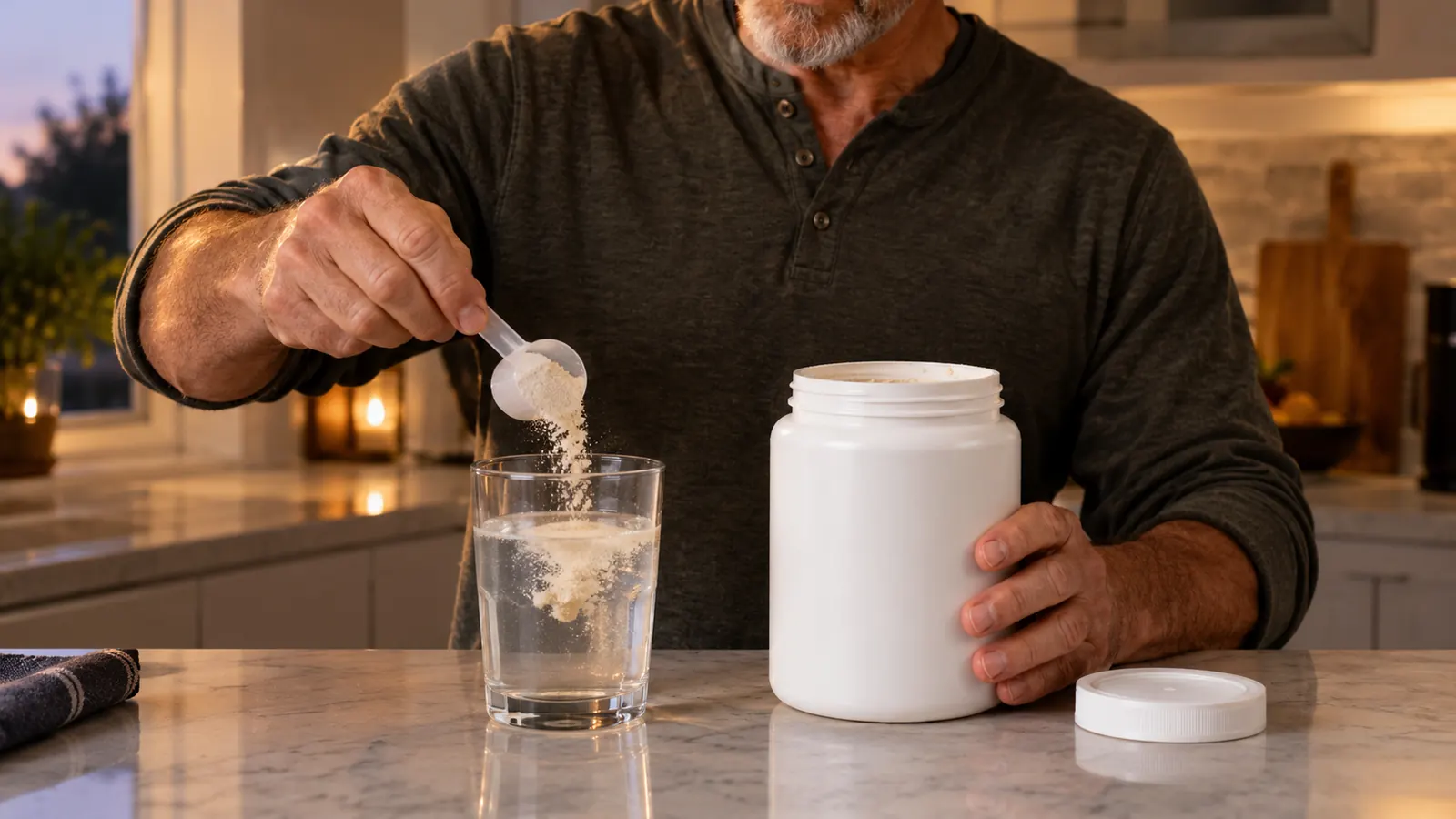
The Optimum Nutrition tub I bought is unflavored, which means it doesn't taste like anything. That's a feature, not a bug. I mix a scoop into a glass of water and I can't taste it. No artificial sweetener aftertaste, no chalky fruit flavor to choke down at six in the morning. If you've ever tried to drink a flavored supplement you didn't like, you know exactly why this matters. The less the powder tastes like something, the less it feels like a chore.
One tub is 240 servings. At one scoop a day, that's eight months of supply. That was the other reason I chose it. I didn't want to think about reordering every few weeks, and I didn't want a product that required me to remember a complicated schedule. I wanted one decision, made once, that would carry me through most of a year.
Step 3: Take one scoop a day and skip the loading phase
The internet will tell you to load creatine with twenty grams a day for the first week. I didn't do that. I started with one scoop, about five grams, once a day. The research on loading is mixed, and the simpler plan is the one that survives contact with a busy life. Loading also tends to cause the stomach upset that makes people quit in the first week, which seems like a bad way to start.
I took it in the evening, as part of my wind-down routine. After training or a hill walk, I'd mix a scoop into a glass of water, drink it, and then do the rest of my evening ritual. That's the whole trick: attach the new habit to one you already have. You don't remember a habit, you just stack it on top of an old one. For me, the creatine glass became the first step of shutting the day down.
Some people take creatine with food, some on an empty stomach. I didn't notice a difference either way. The one thing I did notice is that it dissolves best in cool water and needs a few extra seconds of stirring. It's not a flavored drink mix. It's a plain powder, and it behaves like one. Once I stopped expecting it to dissolve instantly, it stopped bothering me.

Step 4: Give it six weeks before you judge it
Creatine works by helping your muscles produce energy during short, intense efforts. It doesn't work like a cup of coffee. You won't feel it on day three. The research suggests it takes a few weeks for your muscle creatine levels to saturate, and the effects show up in your training log before they show up in the mirror. If you judge it in the first two weeks, you're judging the wrong thing. The studies that look at older adults are the ones that got my attention, because they're measuring something closer to my situation than a study on college athletes.
In my case, the changes were small and specific. Around week four, my last set on the dumbbell bench press went from eight reps to ten. The hill walks with Carol got a little easier on the steeper sections. My right knee didn't suddenly stop being stiff, and I didn't expect it to. My lower back didn't turn into a twenty-year-old's lower back. Neither of those things is what creatine does.
That's the honest version. If you're looking for a transformation in two weeks, you'll be disappointed. If you're looking for a small edge that compounds over a couple of months, that's what this is. I kept my notebook going for nine weeks, and the trend line was steady in the right direction. A couple of extra reps here, an easier hill there. Nothing dramatic, but it added up.
Step 5: Keep it boring and consistent
The mistake people make with any supplement is treating it like a project. They buy the tub, set up an elaborate schedule, miss three days, and quit. The version that works is the boring one: one scoop a day, same time, same glass, no drama. I've been coaching long enough to know that consistency beats intensity every time, and that goes for supplements as much as it goes for interval training.
I missed a day here and there. Travel, a long Saturday of pickleball, a glass I left on the kitchen counter. I didn't double up the next day, and I didn't beat myself up about it. Creatine doesn't require perfection. It requires most days. The people who get results from this stuff are the ones who are still taking it in month four, not the ones who did it perfectly for two weeks. The tub sits on the same shelf as my foam roller and my gym bag, so I see it every single day. Out of sight is out of mind, and I wanted it in sight.
Eight months of supply in one tub helps with this. The cost per day is small, and the habit becomes part of the routine instead of a decision you make fresh every morning. Decisions are expensive. Habits aren't. That's the whole philosophy behind the way I set this up, and it's the reason I'm still taking it nine weeks later.
What Else Helps
Creatine is the supplement part of the equation. The rest of my recovery is a lot less glamorous. I sleep as well as a 58-year-old can, I drink more water than I used to, and I eat enough protein without obsessing over it. After training, I spend ten minutes with a foam roller on the garage floor, mostly on my lower back and my right quad. It's not exciting, but it's the part of the routine that does the most visible work. I also stopped skipping my warm-up sets, which is a boring piece of advice but it's the truth.
The other thing that helps is walking. Carol and I walk the hills around Chattanooga most evenings, and I've come to believe those walks do more for my knees than any supplement. The creatine is the edge. The walking is the foundation. If someone told me I could only keep one of the two, I'd keep the walking and I wouldn't have to think about it.
I also learned to be patient with the small stuff. The creatine didn't fix my sleep or my water intake or the fact that I sit too much on rainy days. It just made the training side of things a little more productive. That's how I'd describe it to a friend: it's a small, reliable edge that works best when everything else is already in place.
If you want the longer version of how the powder performed over the full stretch, there's a separate review on this site that goes into more detail. There's also a comparison between creatine monohydrate and creatine hydrochloride, because that's the question everyone asks in the supplement aisle. And if you're still on the fence about whether creatine makes sense at our age, there's a list of reasons that spells it out plainly.
Around week four, my last set on the dumbbell bench press went from eight reps to ten. That's the kind of small, measurable change creatine gave me.
Start with the plain version
Optimum Nutrition Creatine Monohydrate, unflavored, 240 servings. One scoop a day, no loading phase, no flavoring, no decisions. The simplest version of a supplement with decades of research behind it.
Amazon Check Today's Price on Amazon →