

At 58, I did not expect to be writing about creatine. My training life is modest: three mornings a week in the garage with dumbbells, a bench, and a pull-up bar, plus hill walks with Carol most evenings and pickleball on Saturdays. But about fourteen months ago I started reading the research on creatine for people my age, and the numbers were hard to ignore. So I bought a container of Optimum Nutrition Creatine Monohydrate Powder, unflavored, and started taking one scoop a day. This is what a year of that looked like.
Quick context so you know where I'm coming from: I coached high school track in Chattanooga for over three decades, so I have spent a lot of years telling teenagers to lift more, sleep more, and stop skipping leg day. I retired with a stiff right knee from all those years on the track and a lower back that complains after long days of yard work. Nothing dramatic, nothing diagnosed. I take no prescription medication. I am not a doctor and I do not play one in this review. I can only tell you what I did, what I noticed, and what I would do again.
The Quick Verdict
A year in, I still take it daily. It did not change my life, but it did something measurable: my recovery after hard sessions is better, my knee feels steadier on hill walks, and the cost per serving is hard to beat. I would buy it again.
Amazon Check Today's Price →The same creatine I've scooped every day for a year
If you want the plain, unflavored, well-dosed creatine monohydrate I keep coming back to, it is on Amazon. Check today's price, not what I paid.
Amazon Check Today's Price on Amazon →How I've Used It
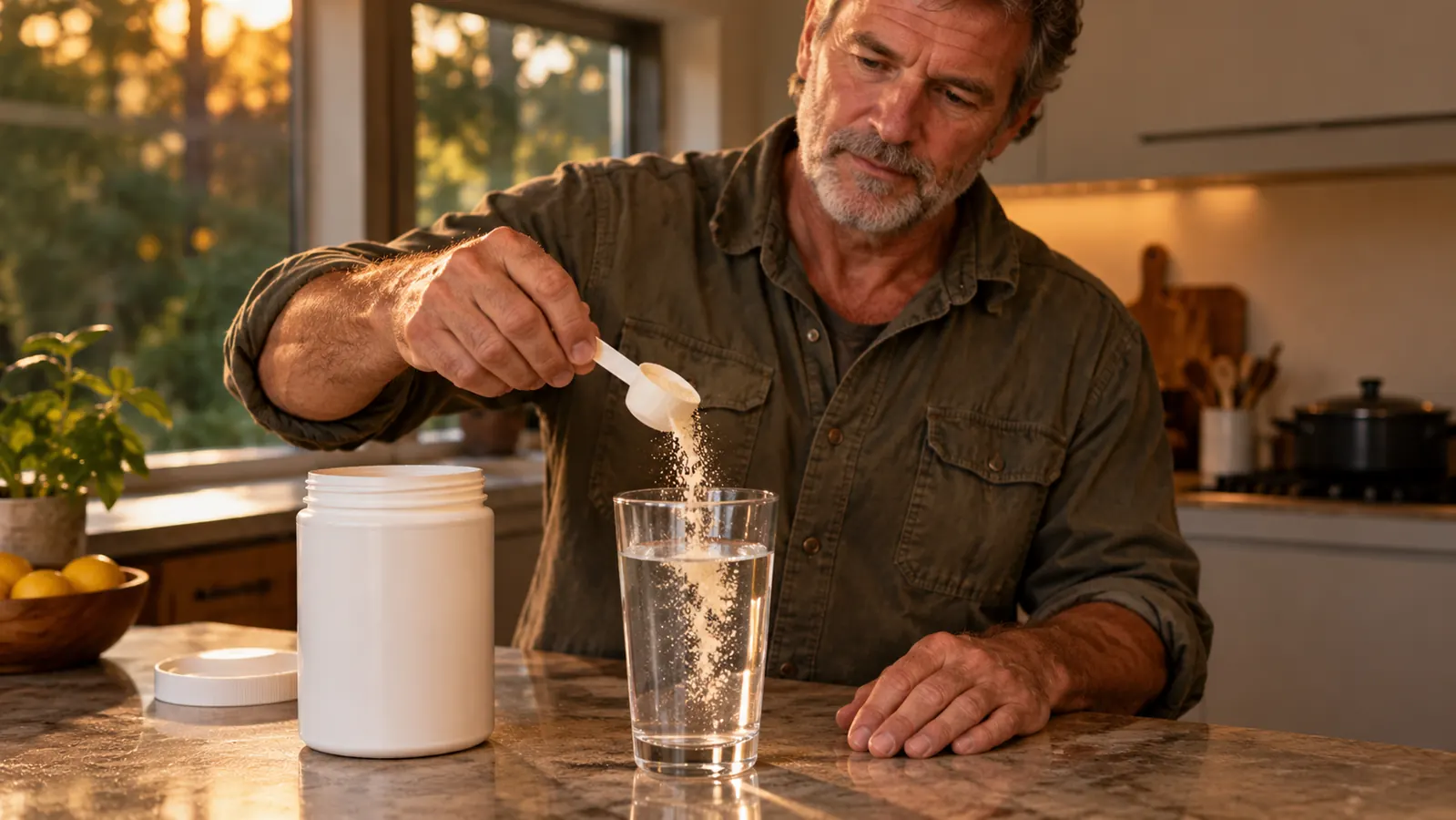
One scoop, most days, with my evening wind-down. After my morning training session I do not rush to a shake; I wait until the evening, when I mix a scoop into about 12 ounces of water and drink it while I cool down. The habit stuck because I tied it to something I already did every night. That is the only reason I lasted a year.
The serving size on the label is 3 grams, about one level scoop. I weigh it sometimes out of curiosity and it is consistently close. I take it seven days a week, including rest days, because the research I read suggested daily saturation matters more than timing. I did not load, I did not cycle, and I did not take it pre-workout with a bunch of other stuff. Just the one scoop.
I chose unflavored on purpose. It dissolves in water with almost no taste and no grit if you give it a minute. I have mixed it into water, into a post-walk glass of iced tea, and once into yogurt when I was curious. It worked everywhere. I cannot speak to the flavored versions because I have not tried them.
Travel was the one thing that threatened the streak. A container that size does not travel, so I would scoop a few days' worth into small zip bags and mix it on the road. It took about two minutes, and it kept the habit alive. If you are a frequent traveler, that is the one piece of advice I would give you: plan for the days you are not in your own kitchen.
Why Creatine Monohydrate, Specifically
The short version: creatine monohydrate is the most studied supplement in strength training, and it has been for decades. The longer version, for people my age: the research I read over about three weeks pointed to the same few things. It helps your muscles resynthesize ATP during short, hard efforts, which is exactly the kind of work I do with dumbbells. It also seems to help preserve strength and lean mass as you get older, which is the part that interested me most.
I am not going to pretend I understood every study. I am a track coach, not a biochemist. But the consistency of the findings was what won me over. This is not a fringe compound with two papers and a marketing budget. It is one of the most heavily researched supplements that exists, and the consensus is unusually boring: it works for most people, most of the time, with few side effects. Boring, at my age, is a feature.
Optimum Nutrition's version is about as plain as it gets: creatine monohydrate, unflavored, in a big container with a straightforward label. There is nothing clever about it, and I mean that as a compliment. When I compared it to the fancy capsules and the buffered versions, the plain monohydrate was the one with the research behind it and the sensible price.
What Actually Changed Over a Year
Here is where I have to be honest, because the internet is full of people who claim creatine turned them into a different person. It did not do that for me. I did not suddenly add fifty pounds to my bench. I did not wake up looking younger. What I noticed was smaller and more useful.
First, my recovery between sessions got better. The second day after a hard leg day used to be the one where stairs were an event. That faded after about six to eight weeks. Second, my right knee, the stiff one from coaching on a track, felt steadier on the downhill parts of our hill walks. I cannot prove creatine did that, and I will not tell you it definitely did. I can tell you the change happened during the same months I was taking it daily, and it has held.
Third, and this is the one I trust the most: my consistency in the garage improved. I am a believer that the best program is the one you actually repeat, and something about the daily scoop made my whole evening routine more deliberate. I slept a little better, or at least I wound down better. The supplement did not do that alone. The ritual did. But the supplement was the anchor.
I kept a simple log the whole year, the same one I have used for decades: date, the lift, the weight, and a one-word note about how it felt. The weights did not climb in a straight line, but the average crept up, and the notes stopped saying things like "knee angry" and started saying "steady." That is not a controlled study. It is just the record of one 58-year-old who took one scoop a day and kept training.
The Tradeoffs Nobody Mentions
The first tradeoff is patience. Creatine is not a pre-workout. You do not feel it on day one, or day ten. People who expect a jolt will be disappointed and will probably quit. For me the effects showed up somewhere around the two-month mark, and they were subtle enough that I almost missed them. If you want a supplement that announces itself, this is not it.
The second tradeoff is water. Creatine pulls water into your muscle cells, which means you need to be consistent about drinking enough. I noticed that on days I slacked on water, I felt heavier and a little sluggish. Nothing dangerous, just uncomfortable. I solved it by keeping a water bottle on the kitchen counter and treating it like part of the routine.
The third tradeoff is the one I did not expect: the container is huge. Two hundred and forty servings is a lot of powder, and it takes up real space on my shelf. That is not a problem for me because I use it daily. But if you are the kind of person who buys a supplement and loses interest in three weeks, a smaller container would waste less money. I will say Optimum Nutrition's unflavored powder has held up fine over the year with no clumping or smell, which surprised me given how long it sat.
One more honest note: the unflavored powder tastes like almost nothing, which is exactly what I wanted, but it does not dissolve instantly. If you stir and drink right away, you will get a few fine particles floating. Give it thirty seconds and a second stir, and it is clear enough. Small thing, but worth knowing before your first glass.
What I'd Compare It Against
I tested the alternatives in the sense that I read about them and talked to a few younger lifters at the gym. Creatine hydrochloride, or HCL, gets marketed as easier on the stomach and needing a smaller dose. The studies I found did not convince me it was better, and the price per gram is higher. I stuck with monohydrate.
The flavored versions of creatine are fine if you want to mix it into a shake, but they cost more and add sweeteners I do not need. The gummies and capsules are convenient for travel but the dose per serving is small, so you end up taking several. For a daily habit at home, plain powder in a glass of water is the cheapest and simplest thing that works. That is the whole review in one sentence.
On cost, the math is simple and it is the reason I stayed with this one. A 240-serving container divided by one scoop a day is eight months of supplement for what the fancier options charge for a month or two. Over a year, that difference is real money, and the plain version is the one the research actually supports. I would rather spend the difference on good food.
What I Notice When I Skip It
A few times over the year, travel got in the way and I missed three or four days in a row. I already knew creatine was not something you feel disappear overnight, so I was not expecting a crash. What I noticed instead was that my first session back felt a little flatter than usual, and the second day after it felt worse than the same session used to feel when I was taking it daily. Nothing dramatic. Just a reminder that the steady habit was doing something.
I also noticed the water thing again on those trips. When I was off my normal routine, I drank less, and I felt it in the gym. That taught me more about how creatine works than any article did: it is not a pill you take and forget. It is a habit that asks you to drink enough and show up consistently. If you can do those two things, it rewards you quietly.
What I Liked
- Plain, unflavored, and easy to mix into water, tea, or yogurt
- One of the most heavily researched supplements in strength training
- Consistent 3-gram scoop, so the daily dose is simple
- A 240-serving container lasts a long time, which keeps the cost per day low
- No jitters, no stimulants, no complicated timing
Where It Falls Short
- Effects are subtle and take weeks to show up, not days
- Requires consistent water intake or you feel heavy and sluggish
- The big container takes up real shelf space
- Not for anyone with kidney concerns without a doctor's sign-off
The effects showed up somewhere around the two-month mark, and they were subtle enough that I almost missed them. That is the honest version of this review.
Who This Is For
This is for the person who already has a routine and wants one small, well-researched addition to it. If you lift, if you walk a lot, if you are over forty and want to keep your strength and your lean mass, creatine monohydrate is about as sensible a place to start as any supplement I know. It is also for the person who can take a scoop every day for two months without expecting fireworks. The reward is real, but it is quiet.
It is also for people who are tired of chasing the newest thing. The supplement industry wants you to believe every year brings something better. Creatine monohydrate has been the same product for decades, and the research keeps landing on the same side. There is a lot of peace in that, especially when you are past fifty and just want to keep doing what you enjoy.
Who Should Skip It
Skip it if you are looking for something you can feel immediately, because you will be disappointed. Skip it if you have kidney concerns, because you should be talking to your doctor about any supplement, and creatine is no exception. Skip it if you will not drink enough water, or if you know yourself well enough to admit that a 240-serving container is a commitment you will not keep. And skip it if you are expecting a transformation, because that is not what this is.
A year of daily scoops, and I still buy the same container
If my kind of quiet, consistent supplement routine sounds like yours, Optimum Nutrition Creatine Monohydrate is the one I keep reordering. Check today's price on Amazon and decide for yourself.
Amazon Check Today's Price on Amazon →