
Most evenings after I train, I spend about ten minutes on the floor of my garage with a foam roller. It is not the most exciting part of my day, and it is not the part I look forward to. It is the part that decides whether I sleep well and whether my right knee complains the next morning. I have been doing it long enough now that it feels strange to skip it.
I did not start with the TriggerPoint Grid. I started with a cheap roller from a big box store, the kind that feels like a pool noodle with a spine. It did not do much. Then a friend at the track let me borrow his Grid, and the difference was obvious enough that I ordered one for the garage. This is the routine I have settled on after using it for the better part of a year. It is not fancy, and it does not take long, but it has become the part of training I look forward to least and miss the most when I skip it.
The roller that earned a permanent spot in my garage
I have used the TriggerPoint Grid on almost every training day for the better part of a year. It is the tool I reach for when my lower back is tight, and it is the one I keep next to the bench for the ten minutes after I train. If you want to try the same routine, this is the roller I would start with.
Amazon Check Today's Price on Amazon →Why I Roll at All
I should say what this routine is not. It is not a treatment for anything, and I am not going to tell you it will fix a bad knee or a sore back. What I can tell you is that I am fifty-eight years old, I spent most of my adult life coaching on a track, and I have a right knee that gets stiff if I ignore it. Rolling is the part of my week that keeps a small tightness from turning into something I think about all day. That is the honest version.
I also like that rolling is quiet and hard to do wrong. There is no screen, no app, no subscription. Just a roller, a mat, and ten minutes. For someone who spends most of the day on his feet, that is a lot of value from one piece of equipment. I am not a coach anymore, but I still think about training the same way I did when I was standing on a track. You do the work, and then you take care of the body that did the work. The routine below is the one I actually do, in the order I actually do it, with the mistakes I made at the start noted along the way.
Step 1: Start ten minutes after your last set, not the second you finish
The biggest mistake I made when I first started foam rolling was doing it too soon. I would rack the dumbbells and drop onto the mat while I was still panting. The rolling felt rushed, my breathing was all over the place, and I did not get much out of it. I thought the point was to do it while the muscles were hottest, and I had the timing backwards.
Now I give myself about ten minutes. I rack the weights, walk a slow lap around the garage, drink some water, and let my heart rate come down. The muscles stay warm from the workout, but I am calm enough to actually pay attention to what I am doing. Ten minutes of cool down first makes the next ten minutes of rolling twice as useful. I would rather start late and do it well than start early and rush it.
Set a timer if you need to. I use the clock on my phone. The point is not to be precise to the minute. The point is to stop treating the roller like part of the workout and start treating it like the start of the recovery. That shift in mindset did more for me than any particular technique. If I skip the cool down, I notice it. The rolling feels hurried, and I rush the parts that need the most time.
Step 2: Calves and hamstrings first
I start with my calves because they are the easiest muscles to reach and the ones that take the most abuse. I walk hills with my wife most evenings, and my calves are the first place I feel a hard hill day. Rolling them first also warms up the rest of the leg for what comes next. If I skip this step, the rest of the routine feels like it starts cold.
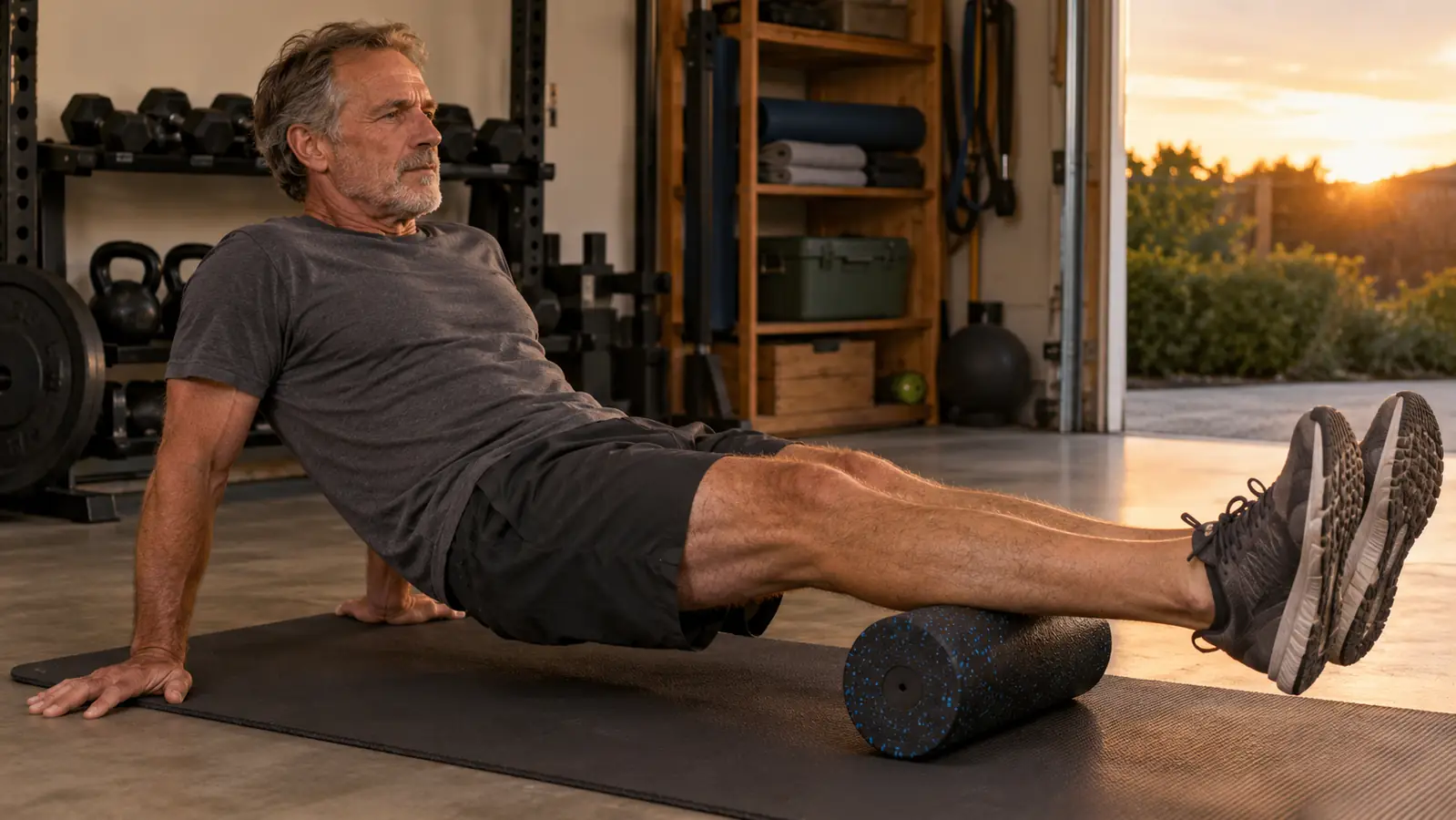
Sit on the floor with your legs straight out in front of you. Slide the roller under your calves, just below the knee. Put your hands on the floor behind you, lift your hips a few inches, and roll slowly from the ankle up to the knee and back. Keep the pressure steady. You are not trying to crush the muscle. You are trying to find the spots that feel tight and give them a little time to loosen.
I do about thirty seconds on each calf, then I move to the hamstrings. Same setup, but the roller sits higher, under the back of the thigh. I bend one knee and keep the other leg straight, which lets me work one hamstring at a time. Thirty seconds per leg is enough. If a spot feels especially tight, I pause on it and take three slow breaths before I move on. Slow and steady beats fast and forceful every time.
Step 3: Upper back, between the shoulder blades
The upper back is the spot most people skip, and I understand why. It is awkward to reach, it looks odd to anyone walking past the garage, and it is hard to tell if you are doing it right. But after three mornings a week of dumbbell work, this is the area that gets tightest for me. It is also the area where the Grid earns its keep, because the multi-density design gives you a firmer section for the bigger muscles and a softer section for the back.
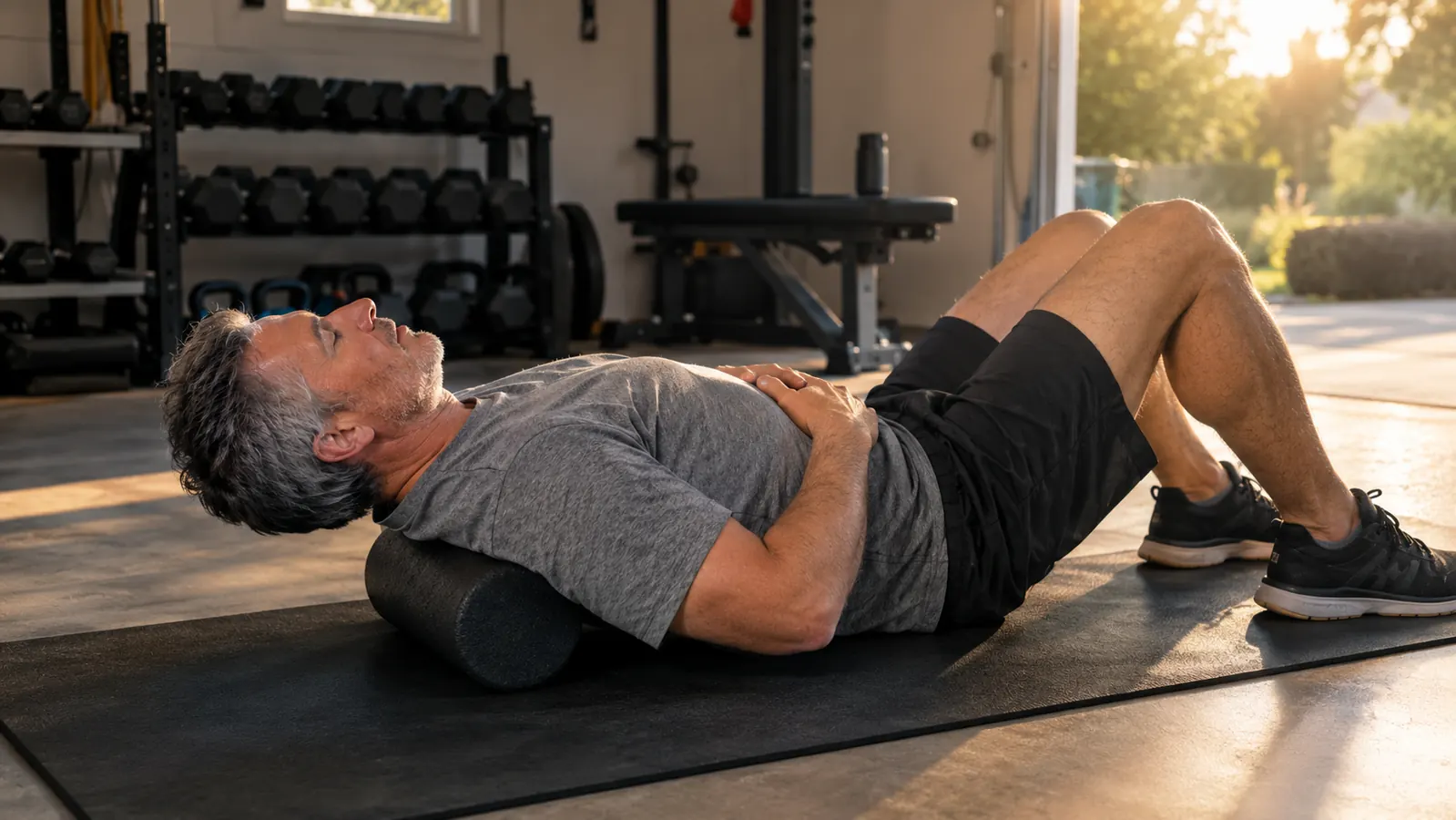
Lie on the floor with the roller under your upper back, positioned so it sits between your shoulder blades. Bend your knees, plant your feet, and lift your hips a little so your weight rests on the roller. Tuck your chin slightly and let your head stay on the floor. Then roll slowly from the base of the neck down to the bottom of the rib cage and back up. Keep your hands behind your head or resting on your stomach, whichever feels steadier.
The common mistake is to keep rolling down into the lower back. I do not do that. I keep the TriggerPoint Grid below my neck and above my ribs, and I stop when I feel the roller reach the bottom of my rib cage. The lower back gets plenty of attention in step four, and it does not need me pressing it into a hard roller. About a minute of slow rolling is all it takes for me to feel the difference.
Step 4: Glutes and hips, the part that matters most for me
I am going to be careful here. I am not a physical therapist, and I am not going to pretend to be one. All I can tell you is how it feels and what it has done for my routine. My right knee has been stiff since my years coaching on a track, and the tightness I feel in that leg usually starts higher up, in the hip and glute. Working that area has done more for how my knee feels than anything else in this routine.
To work the glutes, I sit on the roller and cross one ankle over the opposite knee, like a figure four. Then I shift my weight to one side so I am sitting on that glute, and I roll slowly back and forth. Thirty seconds on each side. The first time I tried this, a tight spot in my right hip eased up faster than I expected, and I knew the roller was staying in the garage. It came back the next day, of course. Nothing here is a one-time fix. But the routine is the point.
Some people prefer to do this part on the floor with the roller under the hip while lying on their side. I have tried that too, and it works fine. I stick with the seated version because it is easier on my knees and I can do it without a mat. Try both and use whichever feels steadier. The goal is the same: slow pressure on the muscle, not speed. If a position hurts, do not push through it. Back off and try a smaller range of motion.
Step 5: Keep it short, then finish with a walk and a stretch
The whole routine takes me about ten minutes, and I think that is the right length. Rolling a muscle for too long can leave it feeling worse, not better. I would rather do ten useful minutes most days than one long session once a week. Consistency is the part that actually works. The roller is not a tool you use when something hurts. It is a tool you use so things do not hurt as much in the first place.
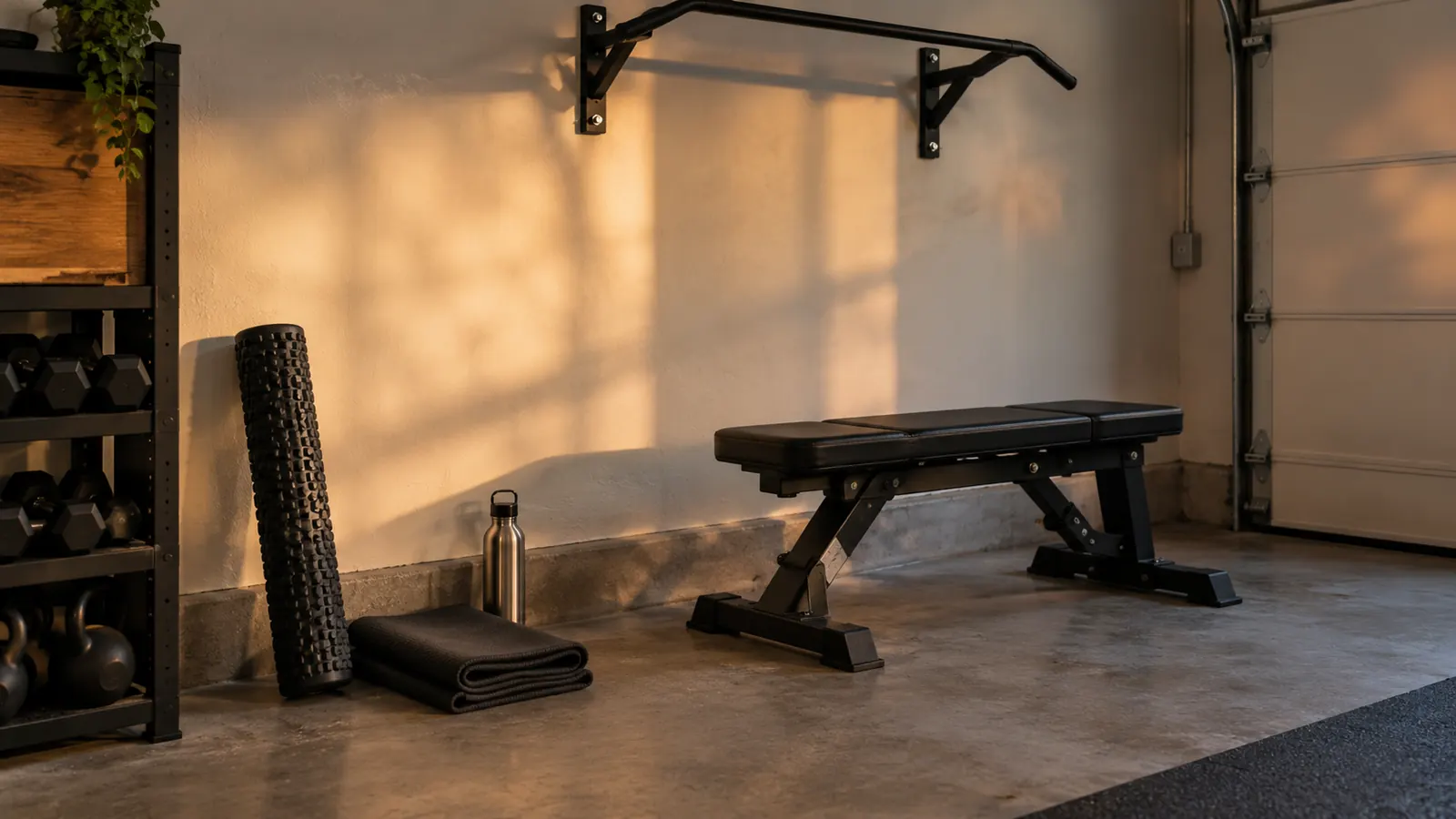
When I am done, I stand up slowly, walk a few steps, and do a standing hamstring stretch, one leg at a time. Nothing dramatic. Then I pick up the roller, lean it against the wall next to the bench, and head inside. It is part of my evening wind-down, the same way a supplement and a quiet few minutes before bed are part of it. The whole thing fits in the time it takes to watch one segment of the evening news.
If you only have five minutes, do the calves, the upper back, and the glutes. Skip the hamstrings. You will still get most of the benefit. The routine is supposed to fit your life, not the other way around. And if you miss a day, do not make a project out of catching up. Just do the next session when it comes around. Some weeks I only manage three sessions. That still beats none. That is the approach that has kept me doing this for the better part of a year.
What Else Helps
The roller does the work, but a few other things make the ten minutes count for more. I drink water before I start, because I roll better when I am not dehydrated. I keep a lacrosse ball by the mat for the soles of my feet, which takes another minute and seems to help everything else. And I try to roll at the same time most days, so it becomes part of the routine instead of a chore I have to talk myself into.
I have had the TriggerPoint Grid long enough that the outer cover shows a little wear, and it still does the job. The firmer sections give me the pressure I want on the big muscles, and the softer sections are what I use on the upper back. I have not found a reason to replace it, and I have not found a reason to reach for the old pool noodle roller again. That is about the highest praise I can give a piece of recovery gear.
The hill walks with my wife and pickleball on Saturdays are the other half of the equation. The roller is not a fix for anything on its own. It is just a way to spend ten quiet minutes letting the day's work settle. I think that is why I have stuck with it. It does not promise much, and it delivers exactly what it promises. In my experience, that is rare enough to be worth holding onto.
The first time I used the Grid, the tight spot in my right hip let go in about two minutes. It came back the next day, but I knew right then the roller was staying in the garage.
Ten minutes, most days, for the better part of a year
That is the whole routine. If it sounds like something you would stick with, the TriggerPoint Grid is the roller I use and the one I would buy again. Check the current price on Amazon and see if it fits your setup.
Amazon Check Today's Price on Amazon →