
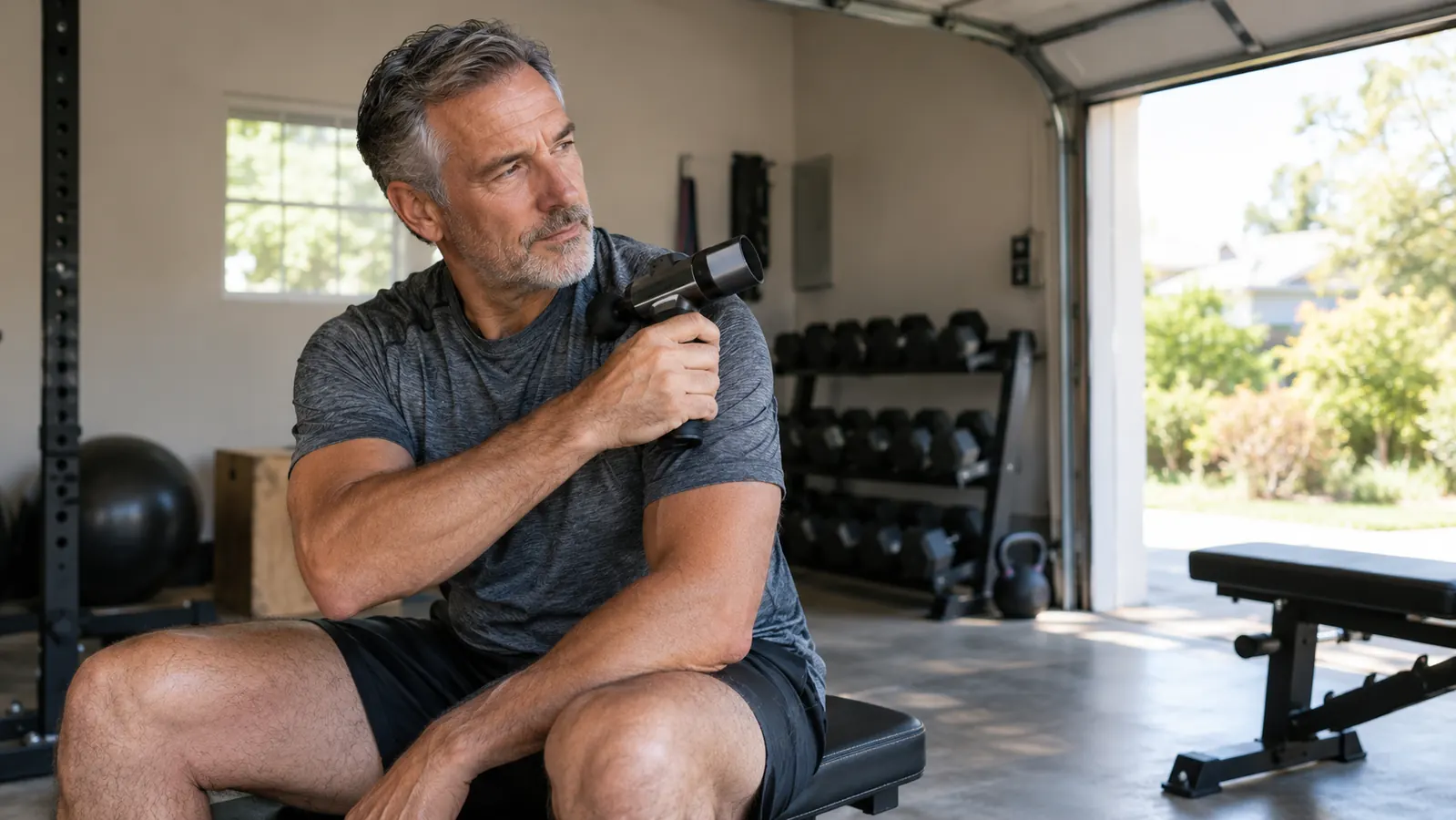
I have been lifting three mornings a week in my garage since I retired from coaching track, and for the last six weeks the Opove M3 Pro 2 has been part of the wind-down after every session. I bought it with my own money, used it on my own schedule, and kept notes the way I used to keep notes on a runner's splits. This is the review I would hand a friend who asked whether the thing was worth the money, and it includes the parts most reviews leave out.
Before I get into the details, here is the short version. The Opove M3 Pro 2 is a solid percussion massager that does what it promises: it delivers deep, steady vibration to sore muscles and it does it quietly enough that I can use it in the living room while Carol reads. It is not a medical device, it will not fix a bad knee, and there are a few annoyances I will get to. But for a 58-year-old whose recovery routine is more about consistency than intensity, it has earned a permanent spot on the shelf next to my dumbbells.
The Quick Verdict
The Opove M3 Pro 2 is the massage gun I reach for most nights. It is quiet, powerful enough for my sore quads and tight lower back, and simple enough that I actually use it. It is not a cure for anything, and the battery life is shorter than I would like, but as a tool for a relaxed evening recovery ritual it is hard to beat at this price.
Amazon Check Today's Price →The massage gun I reach for after every garage session
Six weeks in, the Opove M3 Pro 2 is still the first thing I grab when my legs are heavy or my back is tight. Check today's price on Amazon and see if it fits your routine.
Amazon Check Today's Price on Amazon →How I've Used It
My routine is not complicated. Three mornings a week I do dumbbell work in the garage, and on the other days I walk the hills with Carol or play pickleball on Saturdays. The Opove M3 Pro 2 comes out in the evening, after dinner, usually while I am sitting on the couch or standing in the garage after a session. I spend maybe ten minutes on the areas that actually bother me: the right knee that has been stiff since my coaching days, the lower back that complains after yard work, and whatever else feels tight.
Take last Tuesday as a typical night. I did my usual garage session, five sets of dumbbell rows at 55 pounds, three sets of dumbbell presses at 50 pounds each, and a few sets of pull-ups. My right knee was complaining by the time I racked the weights, the way it does when the weather turns. After dinner I sat on the edge of the couch, put the ball head on the muscles around the knee, and ran it on the second speed for about eight minutes. Wednesday morning I walked the hills with Carol and the knee barely crossed my mind. That is not a medical result, it is just what happened, but it is the kind of thing that keeps me reaching for the gun.
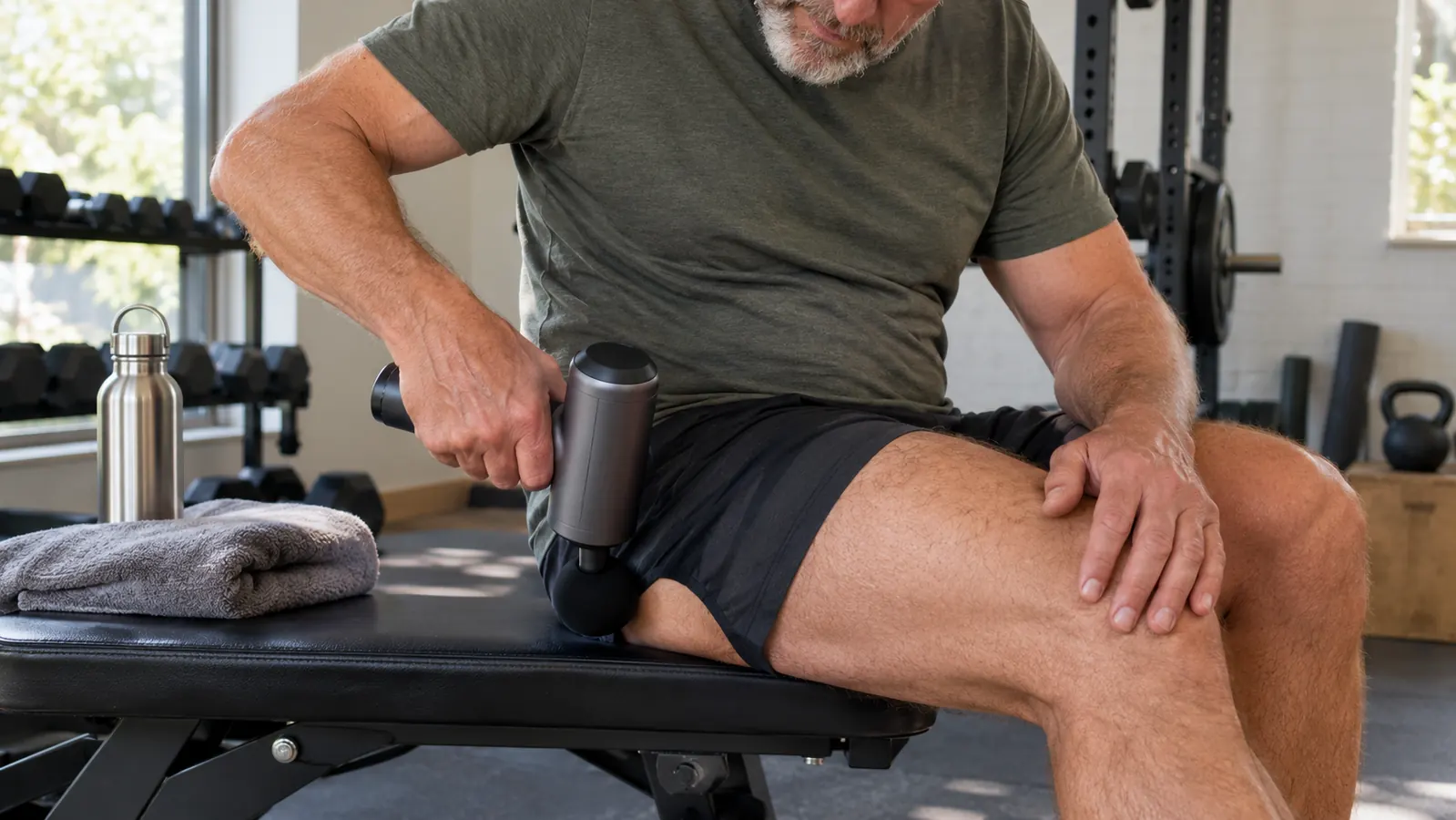
The unit comes with several attachment heads, and I have settled on a simple system. The round ball head for general use, the flat head for my quads, and the bullet head for the spots that need more direct pressure. I do not use the fork head much, it seems designed for the spine and I have no business pressing anything against my spine. I keep the speed on the lower settings most nights, and only occasionally do I push it higher on my hamstrings after a hard hill walk.
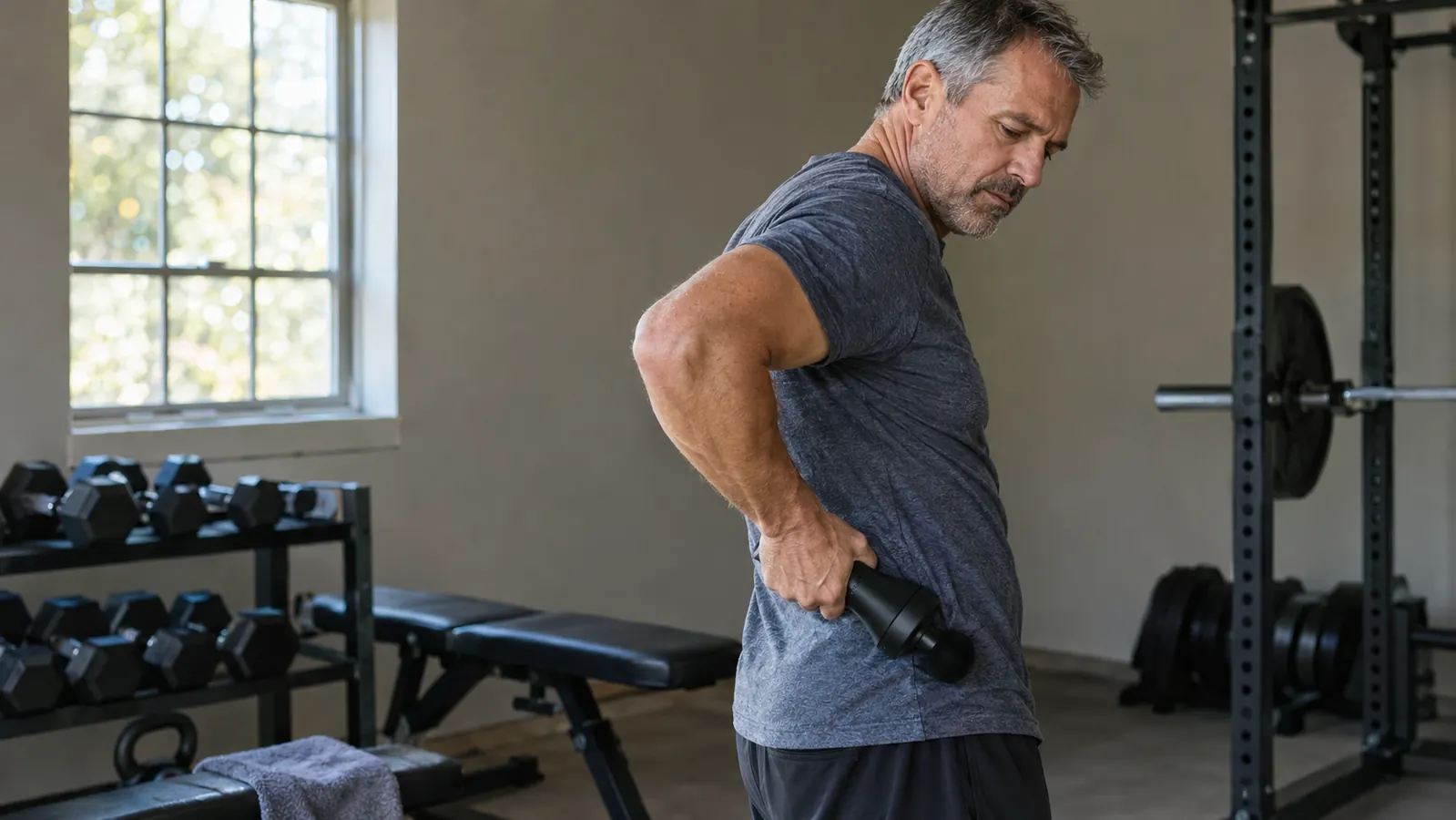
The first week I tried the fork head on my neck and gave up on it quickly. The neck is not a place I want to experiment with a device that strong. The bullet head, though, has become my favorite for the spot in my lower back that knots up after I spend the afternoon moving mulch. I press it against the knot, hold it there on the lowest setting, and within a couple of minutes the muscle lets go. I cannot explain the mechanism and I am not going to try. I just know it works for me.
One thing I did not expect: the Opove M3 Pro 2 has become part of my wind-down ritual, not just my recovery. I take my supplement, I spend ten minutes with the massage gun, and then I go to bed. That consistency matters more than any single session. A tool only helps if you actually use it, and this one is easy to use.
What Nobody Tells You Before You Buy
The honest part. Most reviews describe the Opove M3 Pro 2 in glowing terms and stop there. Here is what I learned that I wish someone had told me.
First, it is louder than the marketing suggests. Not annoying loud, and quieter than most massage guns I have tried, but it is not silent. Carol can hear it from across the room, and if you are planning to use it while watching TV, you will want the volume down. On the low settings it is a hum. On the higher settings it is a definite whir.
I measured it once with a phone app, mostly out of curiosity. On the lowest setting it sat around 45 decibels from about three feet away, roughly the level of a quiet conversation. On the highest setting it climbed into the mid-60s, which is louder than you expect from a device that looks like it should be discreet. Neither level is a problem in a garage, but in a quiet living room at ten o'clock at night it is noticeable.
Second, the battery life is adequate, not impressive. I get about four or five sessions out of a charge, which means I charge it about once a week. That is fine for me, but if you plan to travel with it or share it with a partner, you will want to keep the charging cable handy. It charges with USB-C, which is convenient, but the cable is short.
I timed it one evening out of curiosity. Ten minutes of use on the second speed dropped the indicator from full to about three quarters. The light on the back goes from green to red when it is getting low, and I have learned to charge it when I see red rather than hoping it makes it through one more session. It has never died mid-use, but it came close once, on the night after a long Saturday of pickleball and yard work.
Third, and this is the one nobody mentions: it takes a few sessions to figure out how much pressure is too much. The Opove M3 Pro 2 is strong, and if you press it hard against a sore muscle on the highest setting, you will feel it the next day. I learned to start on the lowest setting and let the device do the work. The pressure should come from the device, not from your arm.
The fourth night I owned it, I made exactly that mistake. My hamstrings were tight after a long hill walk, and I figured more pressure meant faster relief. I put the flat head on my right hamstring, turned it up to the highest setting, and leaned into it the way I might lean into a stretch. It felt fine at the time. The next morning I could barely sit down without wincing. I had essentially bruised the muscle with good intentions. It took about four days to settle down, and I have not made that mistake again.
The Opove M3 Pro 2 is strong enough that I learned to start on the lowest setting and let the device do the work. The pressure should come from the gun, not from your arm.
The Parts That Impressed Me
The first thing I noticed was the build quality. The Opove M3 Pro 2 feels solid in the hand, not like a toy. The grip is comfortable, the controls are simple, and the whole thing is well balanced. I have used massage guns that felt like they would fly out of my hand at high speed. This one does not.
The balance is the detail I notice most. The motor sits in the head of the device, which means the weight is out at the end where you are pressing, not back in the handle. I expected that to make it tiring to hold, and the first session I switched hands a few times. By the second week I stopped noticing it. The grip has a texture to it that keeps the device from sliding even when my hands are a little sweaty after a session in the garage.
The noise level is genuinely good. I have tried a friend's massage gun that sounded like a jackhammer, and I could not use it in the house. The Opove M3 Pro 2 is quiet enough that I can use it in the living room while Carol reads on the couch. That alone makes it more likely to get used, and a tool that gets used is worth more than a tool that sits in a drawer.
The controls are worth a mention because they are the reason this device gets used instead of ignored. There is one button on the back that cycles through the speeds, and a small display that shows the battery. No app, no Bluetooth, no pairing. I am 58 years old and I do not want to open an app to use a massage gun. I press the button, it starts, I press it again to change speed, and when I am done I press and hold to turn it off. That simplicity is a feature.
The battery life, while not amazing, is honest. The indicator light tells you when it is getting low, and I have never had it die mid-session. That is more than I can say for some devices I have owned.
The attachments are easy to swap. They click in and out without fuss, which matters when you are switching between the ball head and the bullet head mid-session. I have owned devices where the heads were a struggle to change, and it made me avoid using them. Not this one. The heads also clean up easily. I wipe them with a damp cloth after I use them, and they look as good as new. After six weeks of regular use there is no cracking or wear around the edges.
What It Did for My Recovery
I want to be careful here, because I do not believe a massage gun is a cure for anything. What I can tell you is how I feel. After a hard leg day, my quads feel less heavy the next morning when I use the Opove M3 Pro 2 the night before. My lower back, which tightens up after a long day of yard work, loosens noticeably after ten minutes on the low setting.
The clearest example came in the third week I owned it. I had spent a Saturday afternoon moving about two dozen bags of mulch, which is the kind of work that puts my lower back into a knot by supper. That night I used the bullet head on the low setting for about twelve minutes, working the area on both sides of my spine. Sunday morning I was surprised at how little the back complained when I got out of bed. I am not going to claim the gun fixed anything, because I have no way to prove that, but the difference was noticeable enough that I wrote it down in my notes.
The right knee is the honest test. It has been stiff since my coaching days, and nothing I have tried has made it feel young again. The Opove M3 Pro 2 does not fix it, and I did not expect it to. But when I use the ball head on the muscles around the knee, the stiffness is less noticeable the next day. That is a real, repeatable effect, and it is the reason I keep the device on the shelf.
The knee effect has been consistent enough that I have a system for it now. I do the muscles above the knee first, the quadriceps attachment, for about four minutes on the second speed. Then I do the calf on the same side for another four minutes. I do not press directly on the kneecap, ever. The theory, as I understand it, is that loosening the muscles around the joint takes some of the load off it. I am not a doctor and I am not going to pretend otherwise. I just know the routine leaves me walking more easily the next morning.
I have also used it after pickleball, which is a different kind of soreness. The quick, stop-and-start movements leave the calves and the Achilles area tight. The most reliable test came on a Saturday in early March. I played three matches, which is more than I usually play, and by the time I got home my lower legs were complaining, especially the Achilles on the right side. That evening I spent ten minutes on the low setting, mostly on the calf muscles, and the next morning I walked the hills with Carol without the limp I expected. I have repeated that routine after every hard pickleball day since, and the result has been consistent. That is the kind of concrete result I look for.
The Pros and Cons
What I Liked
- Quiet enough to use in the living room while my wife reads
- Strong enough for deep tissue work on the lower back and quads
- Simple controls and easy to swap attachment heads
- Solid build quality, comfortable grip, well balanced
- USB-C charging, about four or five sessions per charge
- A reasonable price for what it does
Where It Falls Short
- Battery life is adequate but not impressive, I charge it about once a week
- The charging cable is short
- The volume is higher than the marketing suggests, especially on the top settings
- It takes a few sessions to learn how much pressure is too much
- The fork head is not useful for me, and I do not use it
Who This Is For
The Opove M3 Pro 2 is for someone like me: an active adult over 40 who wants a simple, reliable tool for the evening wind-down. It is for the person who lifts in the garage, walks the hills, or plays a weekend sport and wants something to take the edge off sore muscles without a trip to a therapist. It is for the person who will actually use it, because it is quiet enough to use in the house and simple enough to use without reading a manual.
If you are looking for a first massage gun and you want something that does the job without a lot of fuss, the Opove M3 Pro 2 is a strong choice. It is not the cheapest option, but it is not the most expensive either, and the build quality justifies the price. I would buy it again.
Who Should Skip It
Skip the Opove M3 Pro 2 if you want a device that is completely silent, or if you need a battery that lasts for two weeks of travel. Skip it if you want a massage gun that feels like a professional therapist's table, because no handheld device does that. And skip it if you are looking for a cure for an injury. This is a recovery tool, not a treatment.
I would also say this: if you are the kind of person who buys a piece of equipment and never uses it, save your money. The Opove M3 Pro 2 only helps if it becomes part of a routine. For me, it did. For you, that depends on whether you will actually pick it up after a long day.
Still on the fence? This is the one I kept
Six weeks of honest use, and the Opove M3 Pro 2 is still on my shelf. See today's price on Amazon and decide for yourself whether it belongs in your routine.
Amazon Check Today's Price on Amazon →