
The hill I walk most evenings with Glenn starts behind the high school where I used to coach track. It is not a long hill, maybe a quarter mile of steady grade, but it is honest work. In July in Chattanooga, that hill turns into a wall of heat. By October it is slick with rain, and some weeks this fall we got three walks in, some weeks we got one. My right knee does not care why I missed the hill. It just knows the difference, and so does my lower back after a long day of yard work.
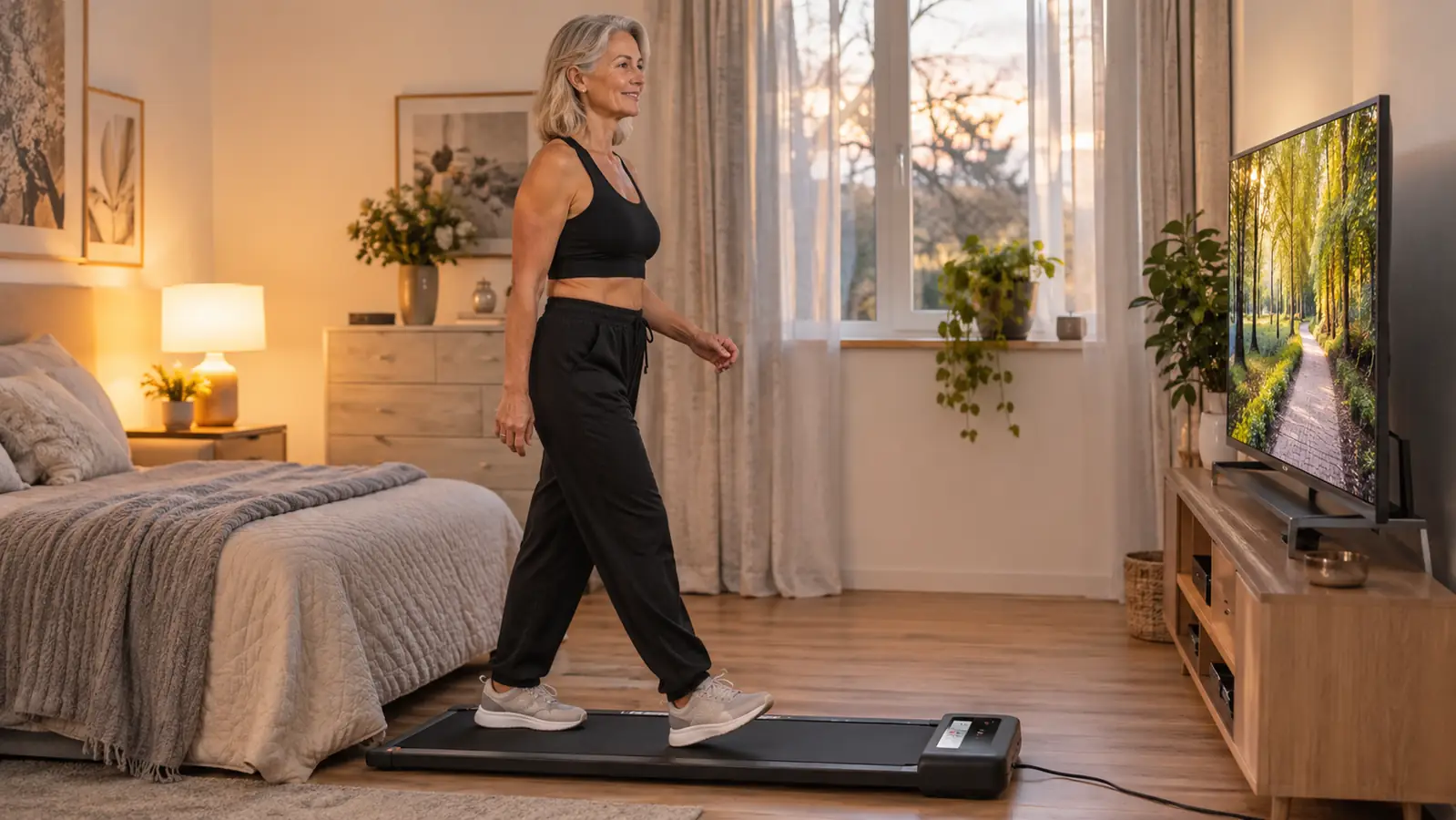
So I bought the MERACH UltraWalk W60 walking pad in July, when the heat first started cutting into our evening walks. It lives in the spare bedroom, facing the TV, and it has been there about four months now. Two or three times a week, on the days the weather wins, I walk 30 to 40 minutes on it with the incline set somewhere between 6 and 12 percent. It does not replace the outdoor hill. Nothing replaces that. It keeps the hill from disappearing entirely.
Keep the Hill When the Weather Takes It Away
The MERACH UltraWalk W60 gives you an auto incline up to 12 percent, speeds up to 4 mph, and a 400 lb capacity in a deck that sits just 6.5 inches off the floor. It is the closest thing I have found to my outdoor hill on a rainy Tuesday.
Amazon Check Today's Price on Amazon →Why the Incline Matters More Than the Speed
Here is what I learned in four months of using this pad. The incline is the whole point. A walking pad with no incline is a treadmill you can only use on flat ground, and flat ground is not what my knees and hips need. The outdoor hill I walk gives me a steady grade, and the MERACH gives me that same grade with the 12 level auto incline. I set it and let the motor do the work. The speed stays at a walk. The incline does the training.
The deck climbs up to 12 percent, and the transition is smooth. The brushless motor with Hall sensor control is rated at 1.25 CHP continuous and 3.5 HP peak, and it has never strained on me. The steel frame weighs 67.7 pounds and is rated for up to 400 pounds, and it does not wobble at any incline I have used. It does not feel like a toy. It feels like a piece of equipment.
Step 1: Put It Where You Will Actually Use It
The first mistake people make with any walking pad is storing it somewhere inconvenient. Mine lives in the spare bedroom, facing the television, plugged into the same outlet the lamp uses. It is 51.4 inches long and 22 inches wide, and it sits 6.5 inches off the floor, so it does not dominate the room. The corded electric power means I needed an outlet within reach, and the wheels mean I can move it aside when I need the floor for stretching.
Having it out and ready matters more than you think. On a rainy evening, the difference between a walk and a skipped walk is often just the number of steps between me and the machine. The remote control stays on the nightstand. The LED display keeps the basics easy to read at a glance. I do not have to drag anything out of a closet or clear a corner. I just step on and go.
One note on placement. Put it somewhere you can see the television or a window, because 30 minutes on a walking pad is a long time to stare at a wall. The built in speaker is there if you want music or a show without headphones, though I usually keep the volume low so I can hear Glenn in the kitchen. The point is to make the walk something you look forward to, not something you endure.
Step 2: Warm Up Before You Step On
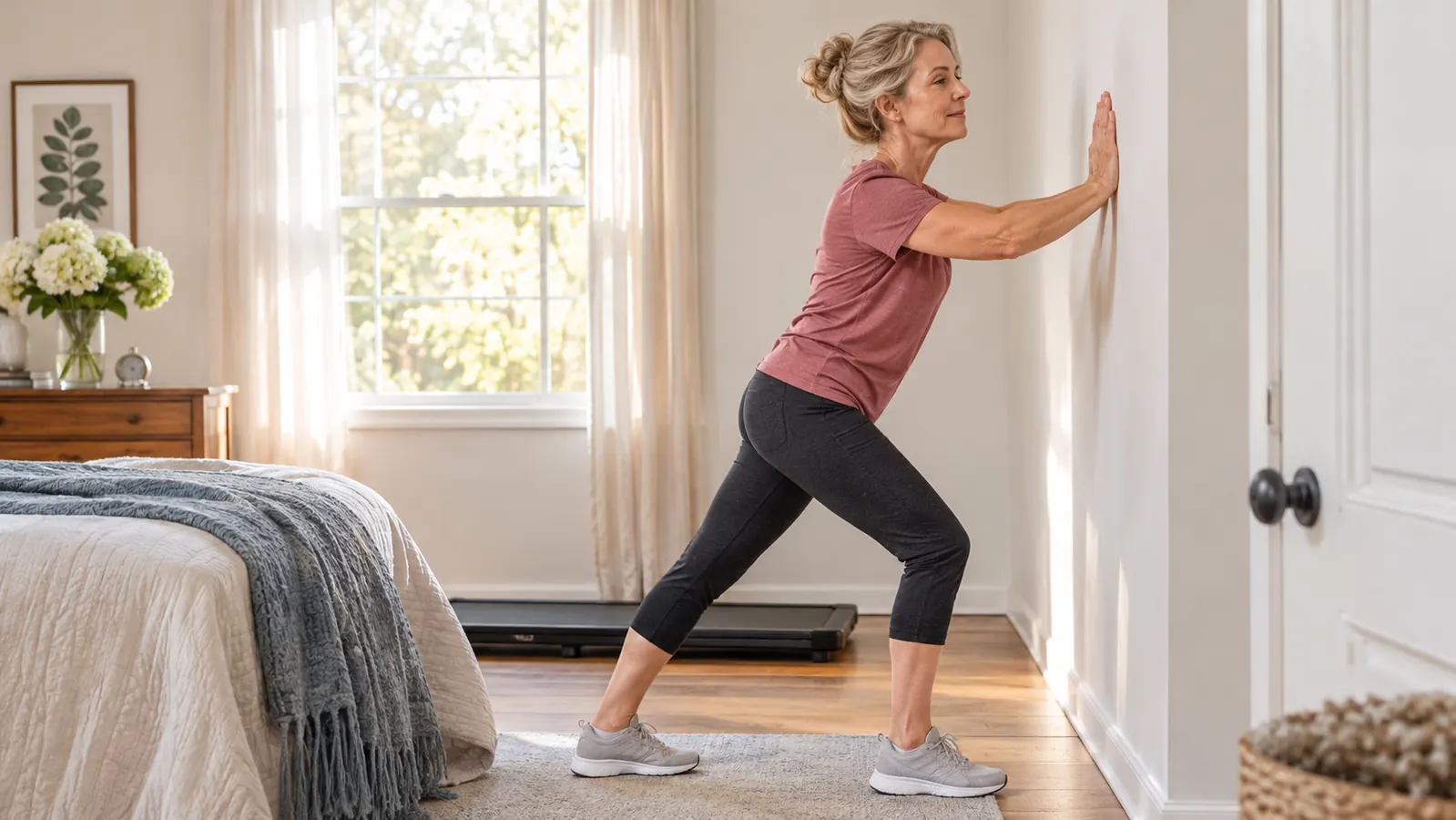
I warm up the same way I do before an outdoor hill. Five minutes of easy leg swings, a few bodyweight squats, ankle circles on each side, and a slow walk around the room. My right knee has been stiff since my coaching years on a track, and it does not care whether the hill is outside or in my spare bedroom. It wants the same courtesy either way.
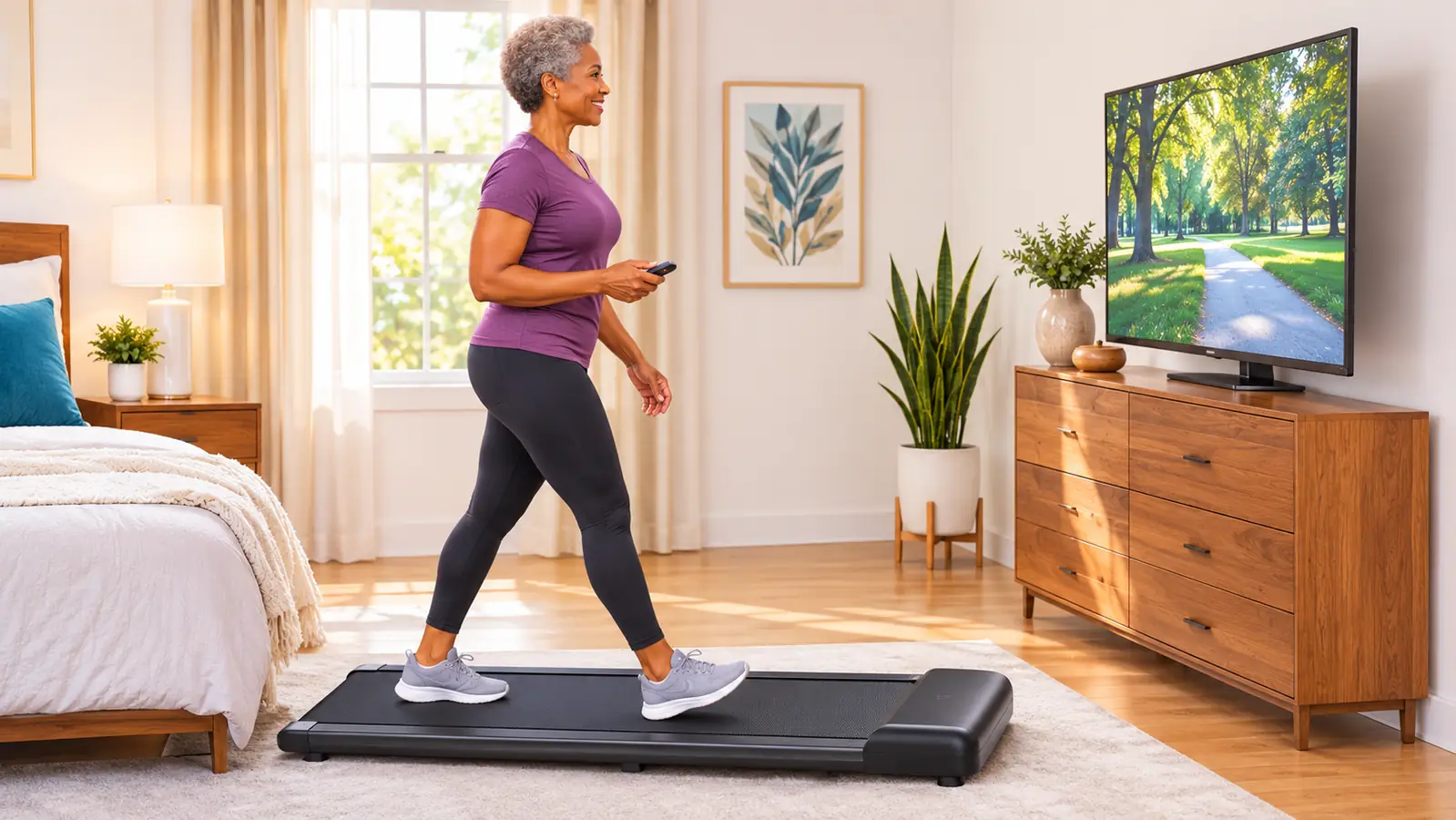
Then I start the pad at a flat setting and an easy pace, around 2 miles an hour, for the first few minutes. The speed is adjustable up to 4 miles an hour, but I am not here to run. I am here to walk the way I would walk outside, and that starts slow. Once my legs feel loose, I reach for the remote and start adding incline. The remote is small and stays in my hand the whole walk, which took me a week to get used to.
The warm up is also when I check in with myself. Some days the right knee is quiet and I know I can push the incline. Some days it is talking and I keep the grade gentler. The pad does not care either way. It will hold 6 percent or 12 percent and everything between. I am the one who decides what the day calls for, and the 12 levels give me room to make that call.
Step 3: Start With a Modest Incline
The auto incline goes up to 12 percent, and that is the number people fixate on. I did not start at 12. I started at 6, and I stayed at 6 for the first couple of weeks. A 6 percent grade on a walking pad is not the same as a 6 percent grade outside, because the belt does the work of moving your feet for you. It feels different in the calves and the hips. It deserves respect.
The remote control makes the adjustments easy. One touch and the deck starts climbing, and the brushless motor with Hall sensor control handles the change without any lurching. I bump the incline a percent or two at a time and give my legs a minute to catch up before I add more. The LED display keeps the numbers easy to read, and the remote means I never have to reach for anything while I am moving.
The 12 percent setting is not a party trick, but it is good to know it is there. On the days when I want a real challenge without leaving the house, I take the incline up to 11 or 12 for a few minutes and then drop it back down. It is the closest thing I have found to the steep stretch at the top of my outdoor hill. I do not live at 12 percent. I visit it.
Step 4: Build the Hill in Intervals
My outdoor hill is a sustained grade, so I do not need a lot of variety to mimic it. Some days I set the incline at 9 percent and leave it there for the whole walk. Other days I do a loose interval pattern: five minutes flat to start, then three minutes at 8 percent, two minutes at 6, then back up. The 12 levels of auto incline give me enough range to make the walk interesting without making it complicated.
I keep the pace at a walk, around 2.5 to 3 miles an hour, and I keep the whole session between 30 and 40 minutes. My Fitbit Charge 6 tells me my heart rate is in the same range as my outdoor hill walks, which is exactly what I want. I never run on this pad. It is a walking pad, and I use it like one. The point is the incline, not the speed.
The interval pattern also keeps the boredom away. Thirty minutes on a walking pad is longer than 30 minutes on an outdoor hill, because the scenery does not change. Breaking the walk into pieces, five minutes here, three minutes there, gives me small goals to hit. When the remote is in my hand and the incline is changing every few minutes, the time moves faster than you would expect.
Step 5: Cool Down, Then Do the Part That Counts
The last five minutes are the same every time. I drop the incline back to zero, slow the pace down, and let my legs wind down while I watch whatever is on the TV. Then I step off and stretch. Calves, hamstrings, hip flexors, and a little extra time on the right side, because that knee is the one that talks to me. This is not optional. It is the part of the walk that keeps me walking.
After the stretch, I use my plain foam roller on my lower back and the Opove M3 Pro 2 massage gun on my legs, the same way I do after an outdoor hill walk. On hot days I add a HydroMATE stick to my 24 ounce water bottle. The whole thing takes about 10 minutes, and it is the difference between feeling like I did something and feeling like I did something I will pay for tomorrow.
I also pay attention to how I feel the next morning. The Fitbit Charge 6 gives me a Sleep Score, and I have noticed that the evenings I walk on the pad are the evenings I sleep best. I am not making a medical claim about any of this. I am just telling you what my routine looks like and how my body responds to it. Your mileage will be different, and that is fine.
What Else Helps
The walking pad is one piece of a routine that has worked for me for years. The Fitbit Charge 6 I wear day and night gives me the honest numbers, steps, heart rate on the walks, and a Sleep Score in the morning. I take Nature Made magnesium glycinate in the evening as part of my wind-down, and I stir creatine and collagen into my morning coffee on training days. None of it is dramatic. All of it is consistent.
The rest of my week still looks the way it always has. Strength work three mornings in the garage with dumbbells, a bench, and the pull up bar. Hill walks with Glenn on the evenings the weather cooperates. Pickleball on Saturdays. The MERACH fits into the gaps. It is the backup plan that actually gets used, which is more than I can say for most backup plans.
What I want you to take from this is simple. The MERACH did not change my training. It removed an excuse. On the weeks when the weather took all five outdoor walks, I still got on the pad two or three times, kept the incline honest, and showed up to my Saturday pickleball game feeling like I had not stopped moving. That is the whole job.
I will say one more thing about the MERACH, and it is the thing that surprised me most. I expected a walking pad to feel like a compromise, a smaller version of the real thing. It does not. It feels like a tool with a specific job, and it does that job well. The outdoor hill is still my first choice. On the days I cannot get to it, this pad is a close second, and a close second is a lot better than nothing.
The first week of October it rained every evening. I still walked three of those nights, 35 minutes each, with the incline at 9 percent. That is what this pad is for.
Give Yourself the Same Hill, Rain or Shine
The MERACH UltraWalk W60 has been in my spare bedroom for about four months, and it has earned its spot. If bad weather keeps cutting into your walks, this is the machine I would buy again.
Amazon Check Today's Price on Amazon →